Blog
Working through the trade-offs behind Massachusetts family housing — with the math shown.
Good school districts didn’t grow faster. In the worst year, they held up better.
“Buy in a good school district and it will hold its value” is two claims, and ten years of Zillow prices for 223 towns answer them differently. Hold the starting price fixed — cheap towns grew fastest, and strong districts are dear — and school tier, test scores and growth explain none of the difference in appreciation: among towns that started between $423k and $536k, strong districts grew 5.53% a year and the rest 5.41%. But in the weakest year of the decade, 18 of the 23 Tier 1 towns did better than their prices predicted, against about half in every other tier.
At three bedrooms, a top school district can cost the state median
Two pieces here say $750,000 reaches no Tier 1 district, which is true of the four-bedroom house. At three bedrooms it is not: the typical three-bedroom home in Westborough, a Tier 1 district, is $685,000 — about what one costs across Massachusetts — and Southborough and Westford come in under $750,000 too. At five bedrooms or more the ticket jumps: only six Tier 1 or 2 towns come in under $1 million, and the cheapest Tier 1 is Westford at $1.19M.
Last year’s hottest Massachusetts towns are rarely this year’s
Many “hottest market” lists are one year of price growth sorted from the top. Ten years of Zillow data say that ranking has lately predicted almost nothing: in each of the last four years, only one or two of the 20 fastest-growing Massachusetts towns were back in the top 20 the next — about what two random lists would share. Even the decade’s steadiest pattern, the cheap towns growing fastest, reversed outright in two of its ten years.
Nine things a Massachusetts listing will not tell you
A listing gives you a price, a tax rate and perhaps a school score, and each one misleads in a way this site’s data can measure: 41% of town pairs rank in opposite order on tax rate and tax bill, the same schools cost $520,000 more one town over, and the graduation rate cannot tell a $450,000 district from a $2.9M one. Here are the nine checks the studies add up to, in the order a purchase actually runs, each with its study’s own figure and a link to the working.
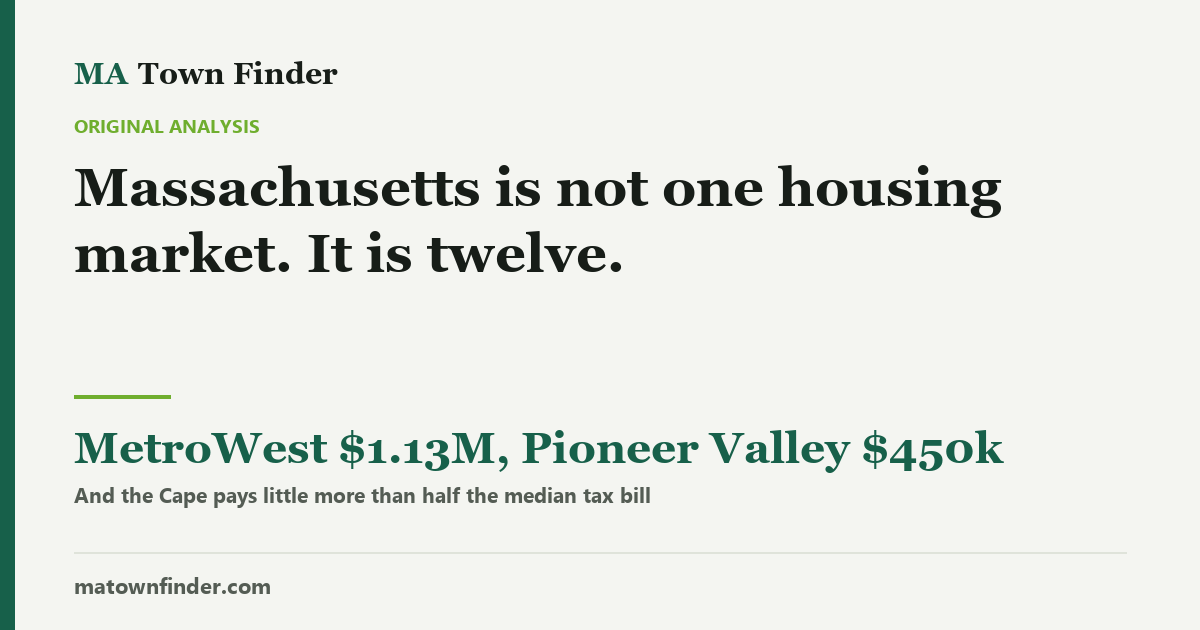
Massachusetts is not one housing market. It is twelve.
Every study on this site pools 223 towns and reports a median that describes nowhere. Split them into the twelve regional planning agency rosters instead and the state resolves into distinct products: MetroWest at $1.13M with the best schools in the state, the inner suburbs at a 25-minute commute and a middling 53rd MCAS percentile, the Cape at little more than half the median tax bill, the Pioneer Valley at $450,000 and two hours out. The map that barely works between towns works between regions — commute predicts regional price at −0.72, and price predicts regional test scores at 0.87.
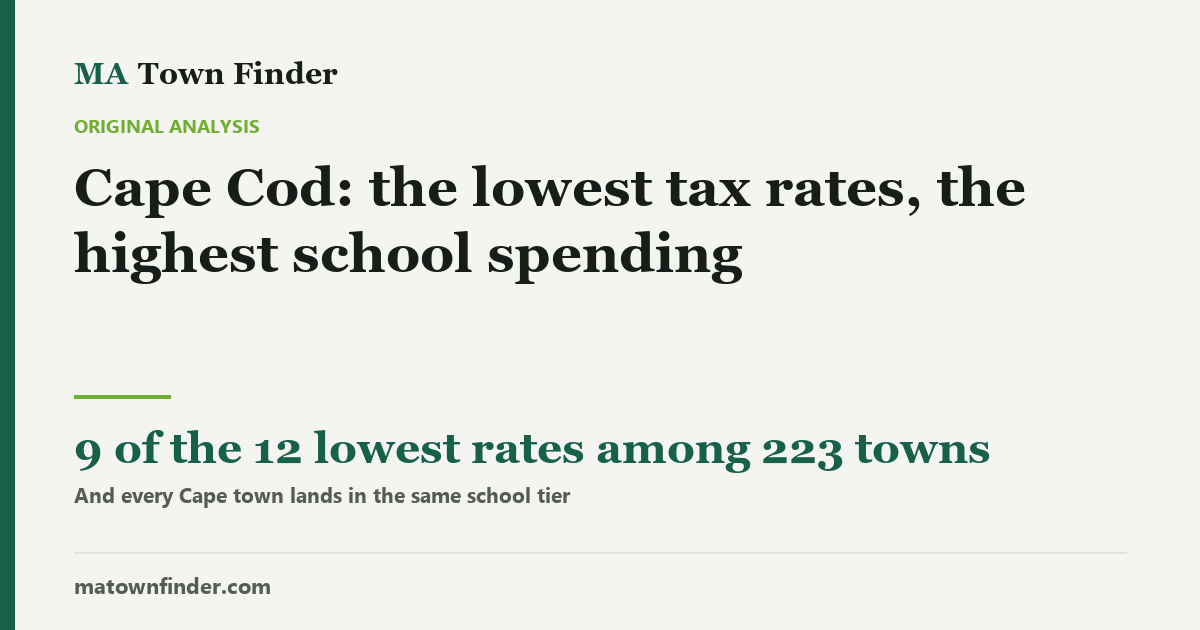
Cape Cod has the lowest tax rates of any region, and spends the most per pupil
Nine of the twelve lowest residential tax rates among the 223 towns this site covers are on Cape Cod, and the median Cape bill is $4,890 against $8,786 across all 223, on houses priced at the same median. Yet it spends $24,828 per pupil, more than any other region. Two other things are true of nowhere else: every Cape town this site covers is Tier 3, the only region of twelve with a single school tier, and four of the ten steepest steps from a three-bedroom home to the top of the market are here.
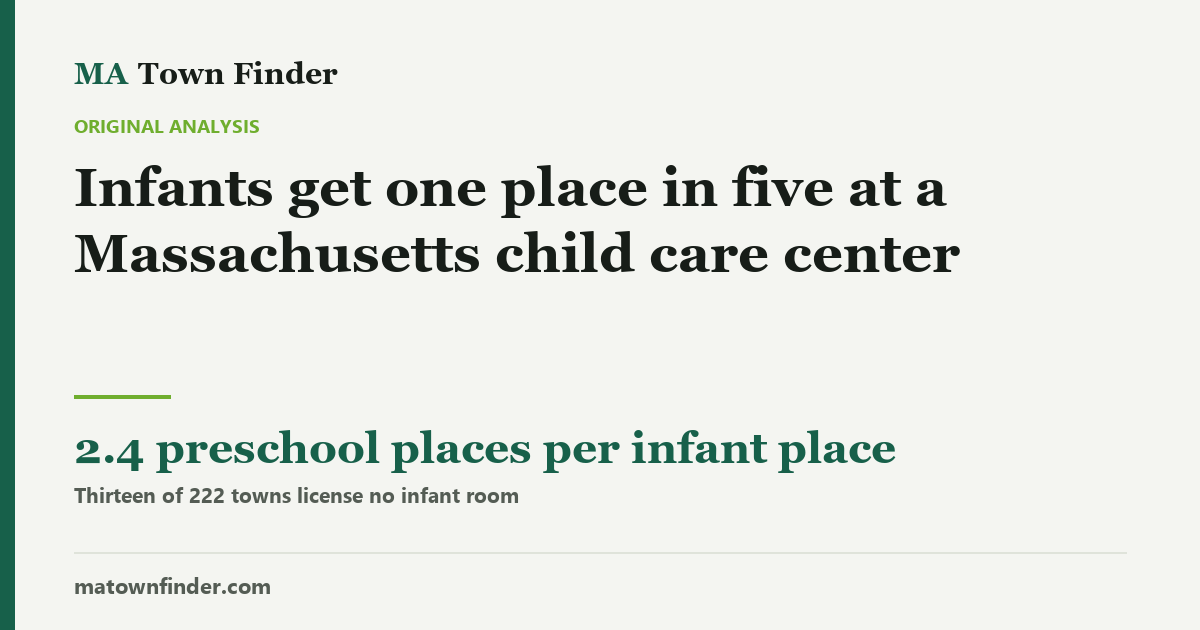
Infants get one place in five at a Massachusetts child care center
A center is licensed room by room, with places recorded per age band, so what it reserves for infants can be read straight off the state’s own file. Across the 183,916 licensed center places in the 222 towns this site covers, 19.5% are infant places, and the median town licenses 2.41 preschool places for every infant place. Dover licenses 135 preschool places and nine for infants. Thirteen of those towns have no infant room in any center at all — and in Chatham there is no home-based program either.
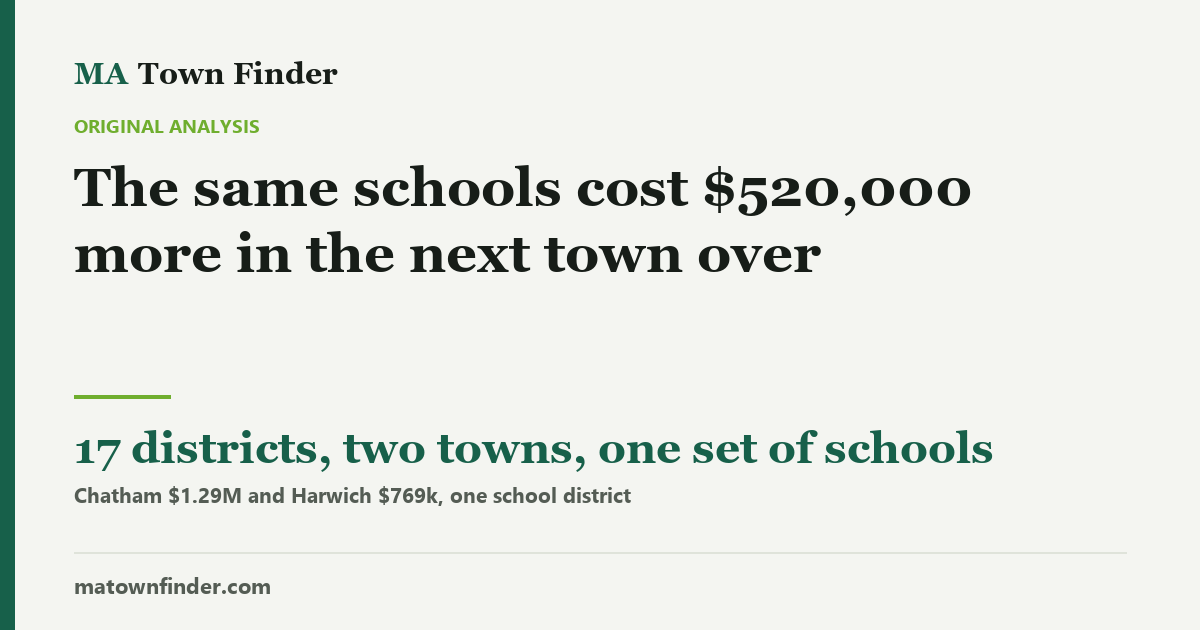
The same schools cost $520,000 more in the next town over
Among the towns this site covers, seventeen districts enroll children from more than one town into the same buildings — same teachers, same superintendent, one state rating, one per-pupil figure. That makes them the only clean test of what a district is worth, because the schools are held constant and everything left over is the town. Chatham and Harwich share Monomoy, and the typical three-bedroom home is $520,000 dearer in Chatham. Nine of the seventeen have a member town at least a tenth cheaper than its neighbor.
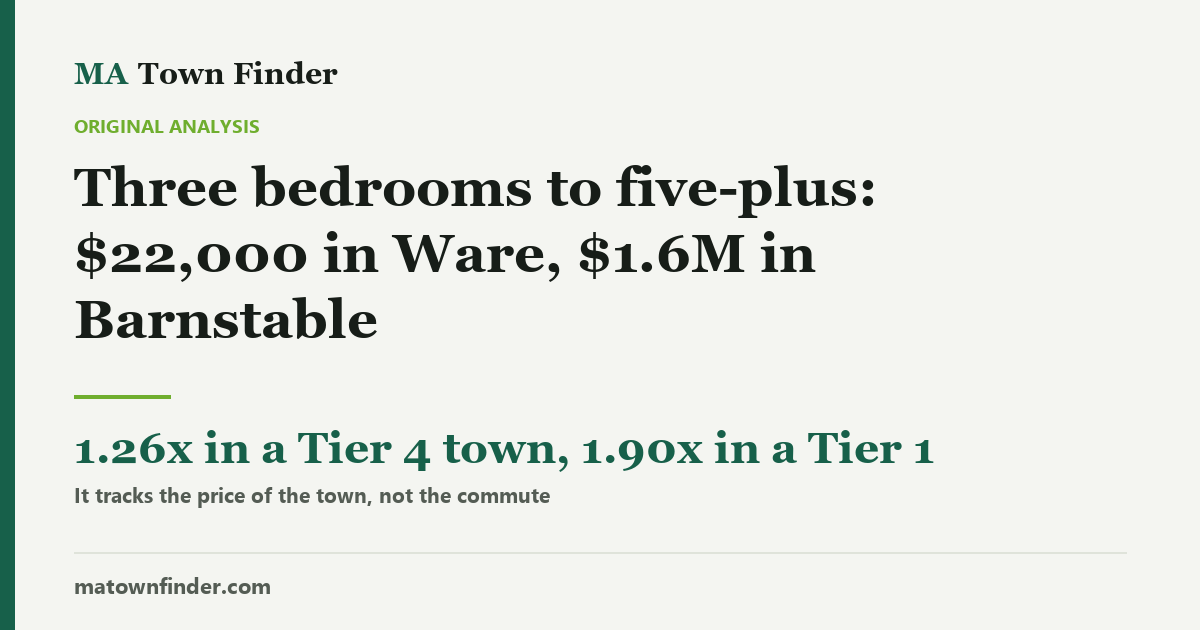
Three bedrooms to five-plus costs $22,000 in Ware and $1.6M in Barnstable
Zillow publishes its price index split by bedroom count, so the cost of space in a town can now be read off a source instead of modeled. Statewide the step from a 3BR to the 5+ BR bucket is 1.44x — but it is 1.06x in Ware and 3.23x in Barnstable, and what sorts them is the price of the town (r = 0.60), not the commute (r = −0.03). Across the towns this site covers, the market for small homes runs 5.7-fold; the market for big ones runs 12.3-fold. In 39 towns the whole top of the local market costs less than a typical three-bedroom statewide.
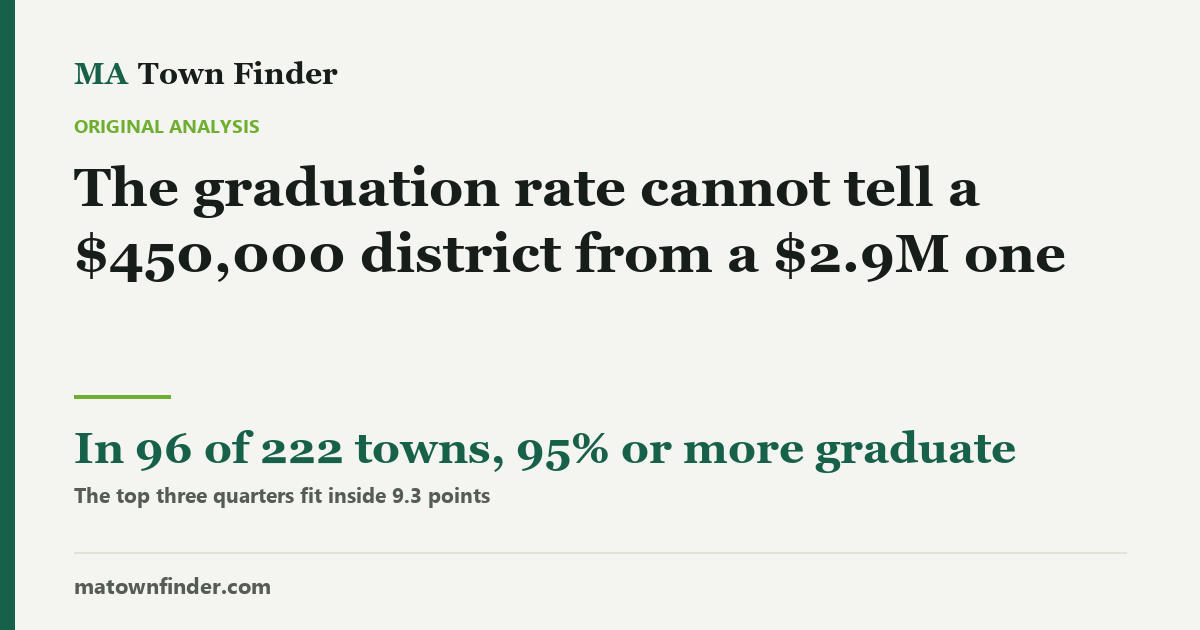
The graduation rate cannot tell a $450,000 district from a $2.9M one
In 96 of 222 Massachusetts towns, the local district graduates 95% or more of its students, and those towns run from $450,000 to $2.9M. The top three quarters of them fit inside 9.3 percentage points, so the measure has no room left to separate anybody: Weston is 97.7% at $2.9M, Southwick 96.5% at $450,000. The highest rate here is not in a Tier 1 town, or a Tier 1 price. What the number does do is find the floor — and that part is worth reading.
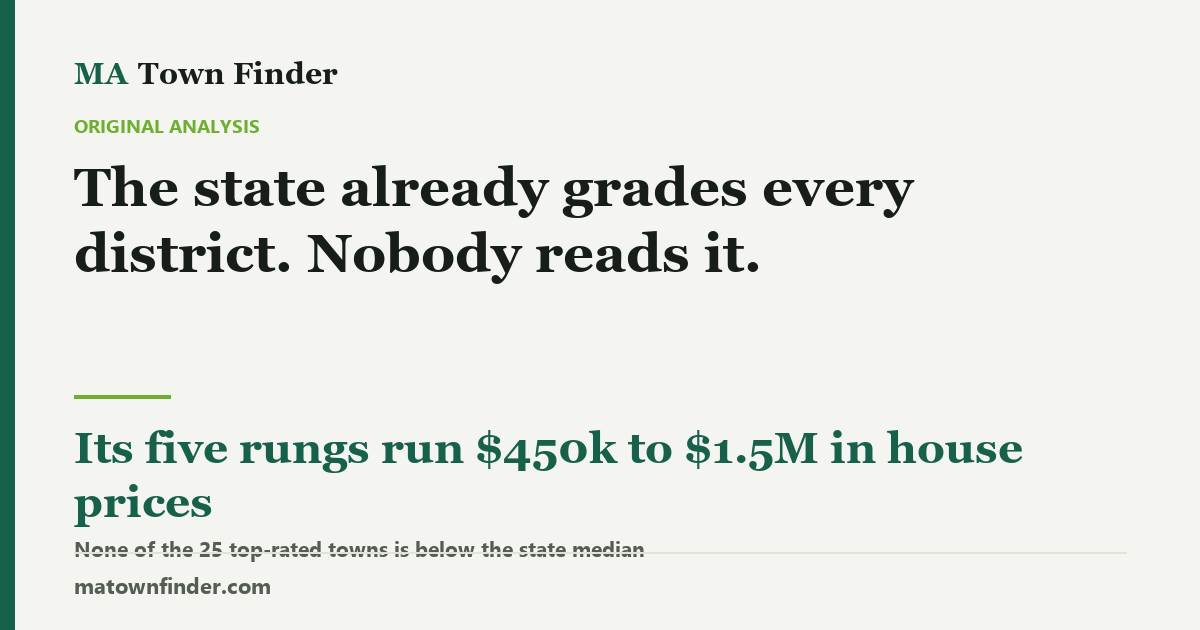
The state already grades every district. It costs $950,000 to buy into the top of it.
Families compare districts with Niche grades and US News rankings, all of them commercial and all scored differently. Massachusetts issues its own determination for every district in one line of plain English, free, and it lines up with house prices almost perfectly — $450k at the bottom rung, $1.5M at the top. Of the 25 towns the state says are meeting or exceeding their targets, not one is priced below the statewide median.
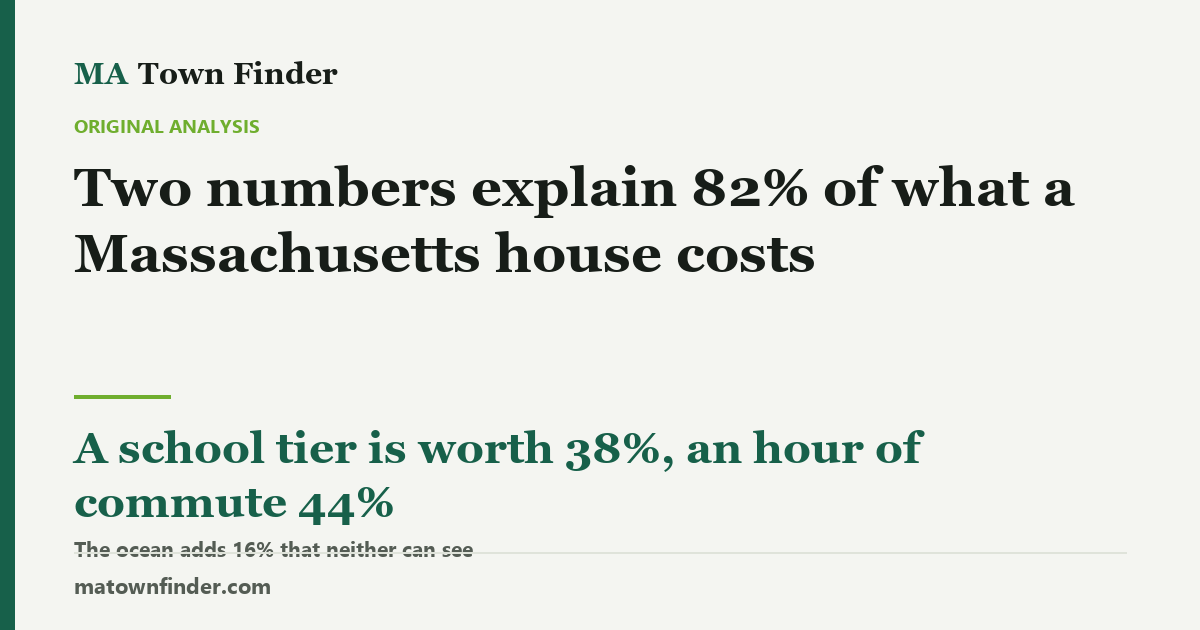
Two numbers explain 82% of what a Massachusetts house costs
Fit the price of all 223 towns against just the school tier and the commute to Boston and you capture 82% of it: each tier is worth about 38%, each commute minute about 0.6%, so an hour costs 45%. The leftovers are the interesting part. The ocean adds 16% that neither variable can see — and a Tier 1 district, which sells at a 19% premium close to Boston, sells at an 18% discount an hour out.
Peabody is America’s hottest ZIP code. Its tax bill is the real story.
Realtor.com named 01960 the hottest ZIP code in the country and the coverage gave four reasons: affordable, a revived downtown, low taxes, good highway access. Checked against the data, three hold — and the tax one is far stronger than reported. Peabody’s estimated bill is the second lowest of the 18 North Shore towns, less than half what Wenham or Topsfield pay. The fourth reason is the polite version of something the coverage does not mention: there is no train.
The pandemic re-priced Massachusetts by distance, and never gave it back
Prices rose most where the commute was longest — an hour out gained 37.4% between 2019 and 2022, the inner ring 25.7%. The half of the story everyone expected next has not happened. Four years past the peak the towns that boomed hardest are still growing fastest, one town in 223 is below its 2022 price, and the gap between the inner ring and the far suburbs has widened by 22 percentage points rather than closing.
Four of Boston’s job centers are the same commute. Longwood is not.
Every commute figure published anywhere, including everywhere else on this site, is a journey to downtown Boston. Measured against real MBTA timetables from 79 rail-served towns, Back Bay costs 7 minutes more than downtown, the Seaport 5, Kendall 8 — and the Longwood Medical Area 25. The remarkable part is how little that varies: 96% of towns land within a 20-to-30-minute penalty, because the network is built to deliver people to South Station and North Station and Longwood is neither.
The child care near you depends on what your town costs
Massachusetts licenses two different things under one word: centers on commercial premises averaging 69 places, and family programs in a provider’s own home averaging eight. Two programs in three are the home kind — but which one is near you tracks what the town costs. In the cheapest quarter of towns, 67% of programs are somebody’s home; in the dearest, 25%. Eleven towns have no home-based program at all, Weston, Dover and Carlisle among them.
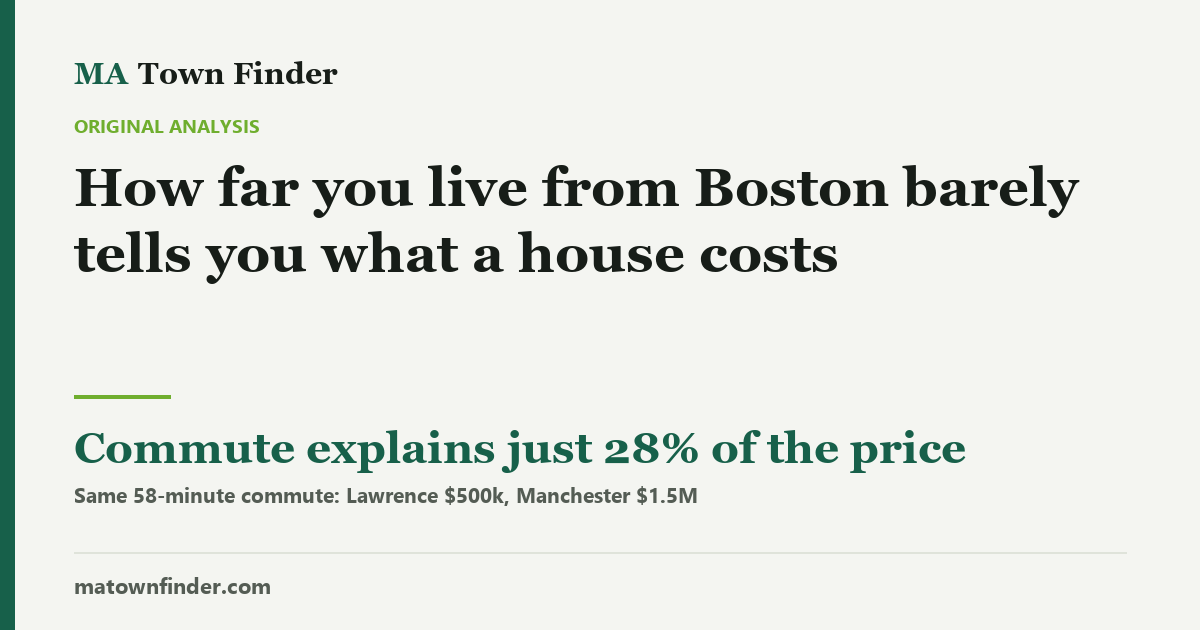
How far you live from Boston barely tells you what a house costs
Distance is supposed to be the master price knob, but commute time explains just 28% of what a house costs. The median is flat across the whole first hour, and at any given commute prices run nearly threefold — Lawrence and Duxbury are the same 58 minutes from downtown, at $500k and $1.4M. The town decides the price, not the map.
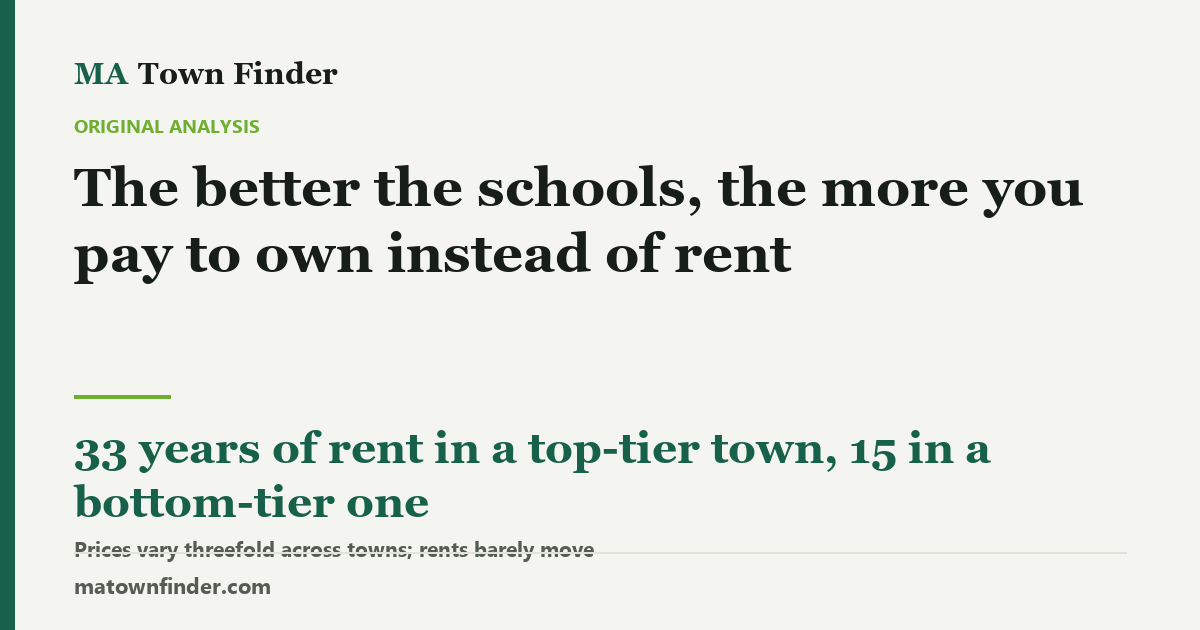
The better the schools, the more you pay to own instead of rent
Price-to-rent — the years of rent that equal a home’s price — runs from about 9 in the Gateway Cities to 61 in Weston. It climbs cleanly with school tier: a top-tier-school town costs 32 years of rent, a bottom-tier one 14. The reason is that prices vary threefold across towns while rents barely move, so the school premium lands in the sale price, not the rent.
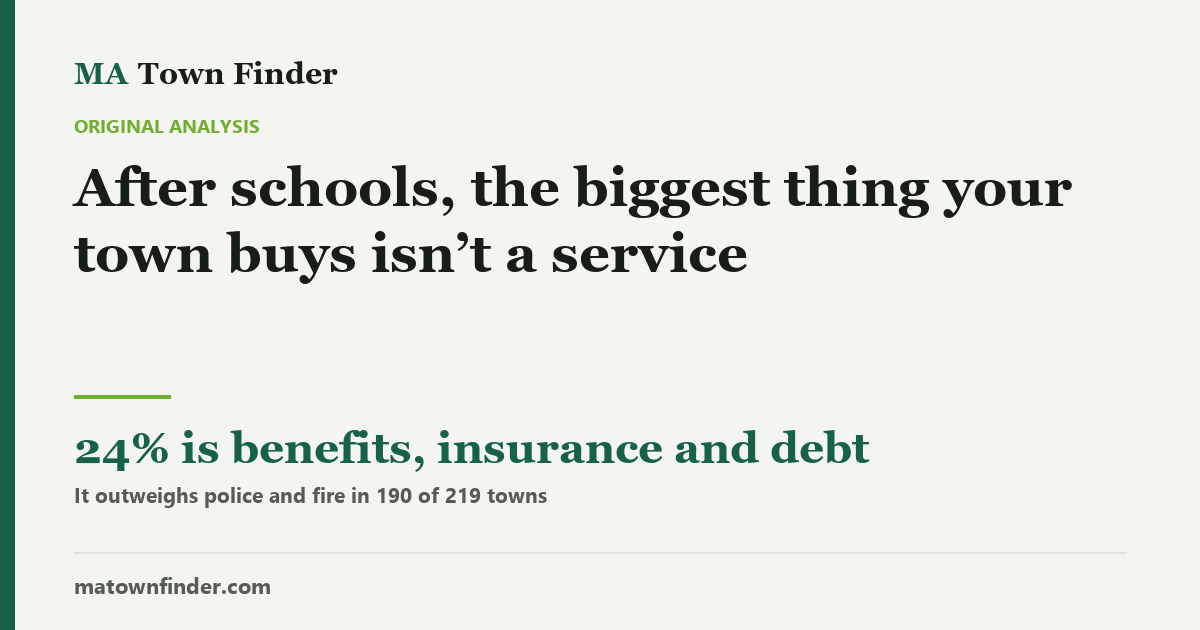
After schools, the biggest thing your town buys isn’t a service
Half the budget is schools. The next-biggest slice — 24% statewide — buys no service at all: it’s employee and retiree benefits, insurance, and debt. In 190 of 219 towns those obligations outweigh police and fire combined, and it tracks a town’s size and age, not its wealth.
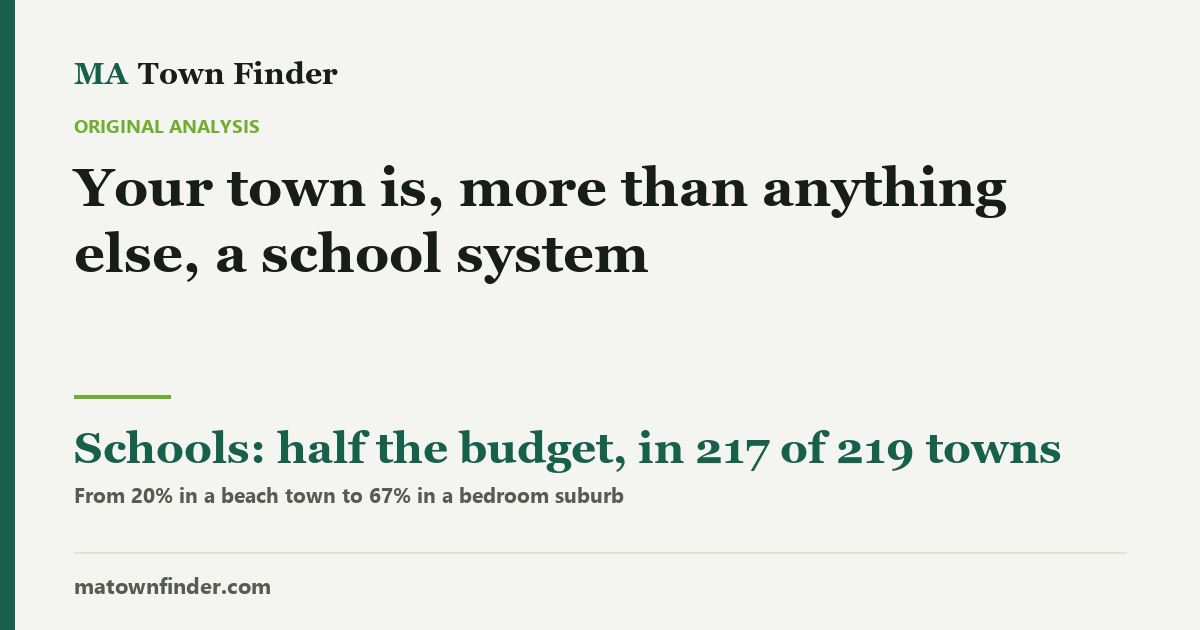
Your town is, more than anything else, a school system
Break 219 Massachusetts town budgets into their ten categories and one line wins almost everywhere: education is the single biggest expense in 217 of them, about half of all spending, four times what a town spends on police and fire. The share runs from 20% to 67% — and what moves it is the kind of town, not how rich it is.
Your town’s tax rate tells you almost nothing about what it spends
Real FY2025 budgets for 221 towns. Municipal spending per resident runs from about $2,000 to $8,600 — and how much a town spends has essentially no relationship to its tax rate (r = −0.06). It tracks property wealth instead. Chatham spends $8,344 a head at a $3.67 rate; Athol spends $2,124 at $12.67.
Walkability, culture, gathering places: none of it moved house prices
Ten years of prices tested against the things people say drive property values. Once you allow for the fact that cheap towns grew fastest, none of the six town-character measures predicts anything at all. One thing survives, and it is the water.
The cheap towns grew fastest. The expensive ones made far more money.
Ten years of Zillow data for 223 towns. In percentage terms the gap closed: the cheapest quarter grew 6.7% a year against the dearest quarter’s 5.4%. In dollars it opened by $246,000. Both are true, and which one matters depends on whether you already own.
Test scores tell you who moved in. Growth tells you what the school did.
Massachusetts publishes two figures for every district and buyers read one. Achievement explains just 42% of growth — and the part it misses is almost unrelated to house prices. At every score level, districts differ by up to 18 points on how far they move children.
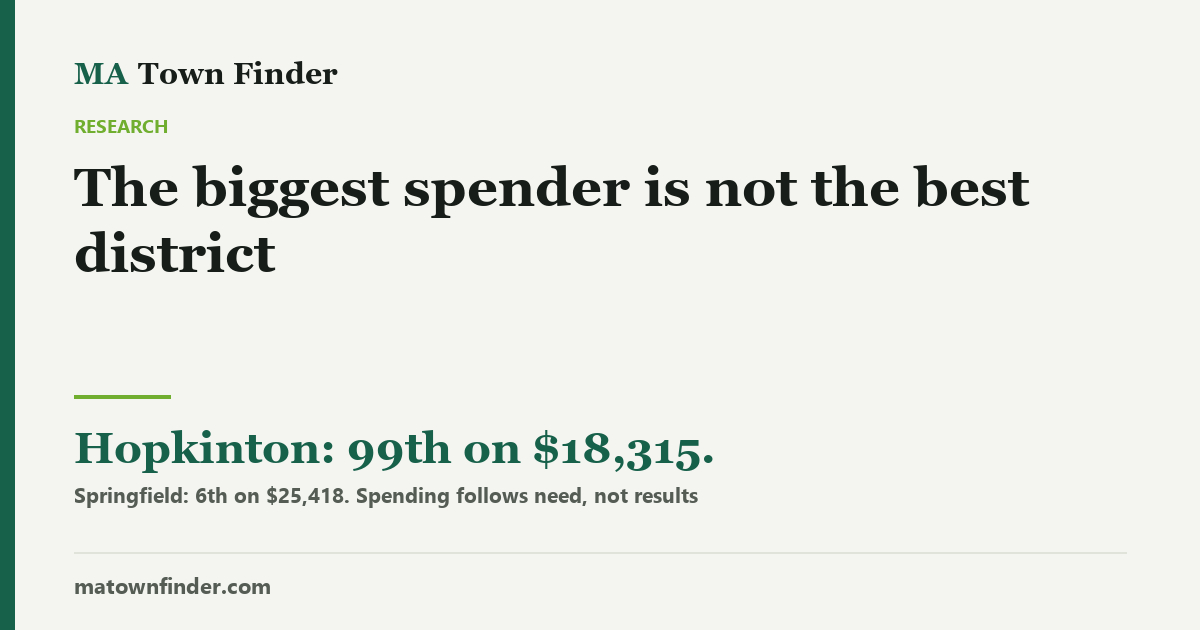
The district spending the most per pupil is not the best one
Across 203 Massachusetts districts, per-pupil spending tracks house prices far more closely than it tracks results. The lowest-scoring quarter of districts spends the most. Hopkinton reaches the 99th percentile on $18,315; Springfield reaches the 6th on $25,418.
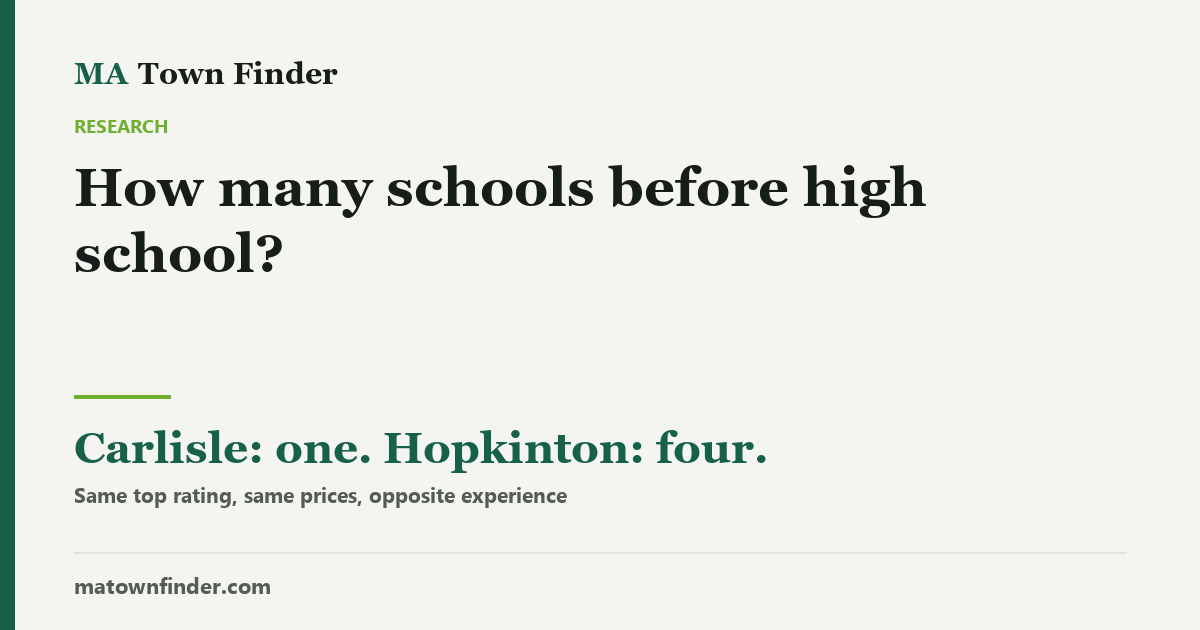
How many times will your child change schools before high school?
In Carlisle the answer is never — one building from kindergarten through eighth grade. In Hopkinton, a district sitting at the identical MCAS percentile, it is three moves in nine years. No ranking mentions this, and it predicts nothing about quality.
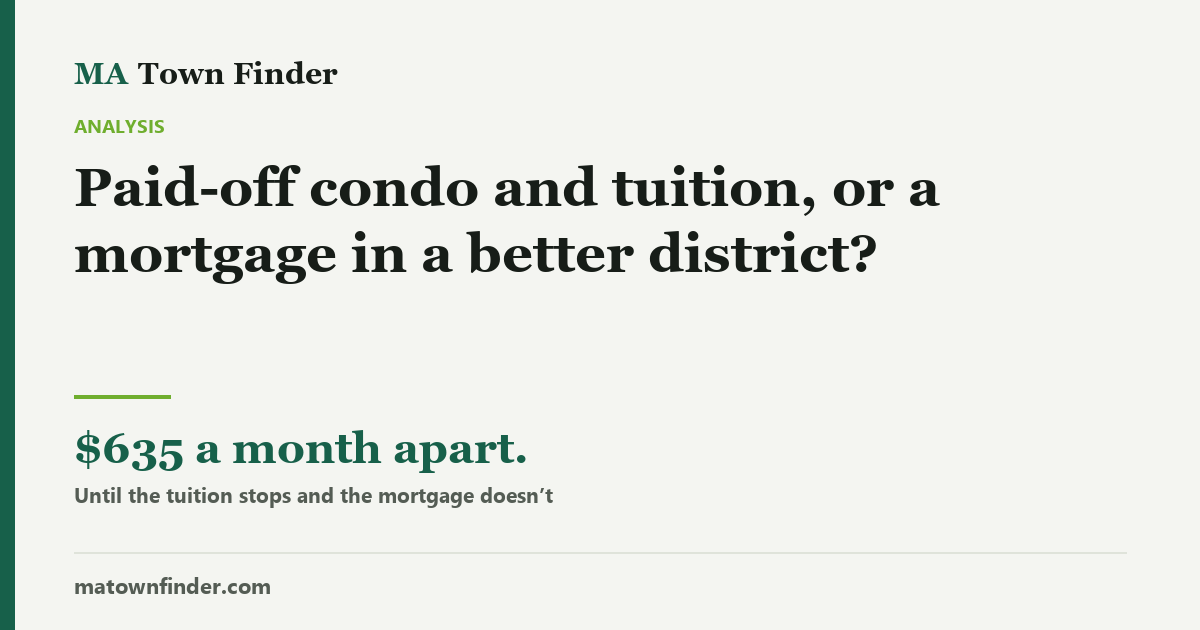
A paid-off condo and private school, or a mortgage in a better district?
A worked comparison with two children aged four and newborn: a mortgage-free Salem condo with $624,000 of private-school fees ahead of it, against a $1.25M house in Marblehead with a $550k mortgage and free public schools. At inflation the two are finely balanced. At the rates both towns actually delivered over the last decade, it is not close — and that gap is the whole decision.
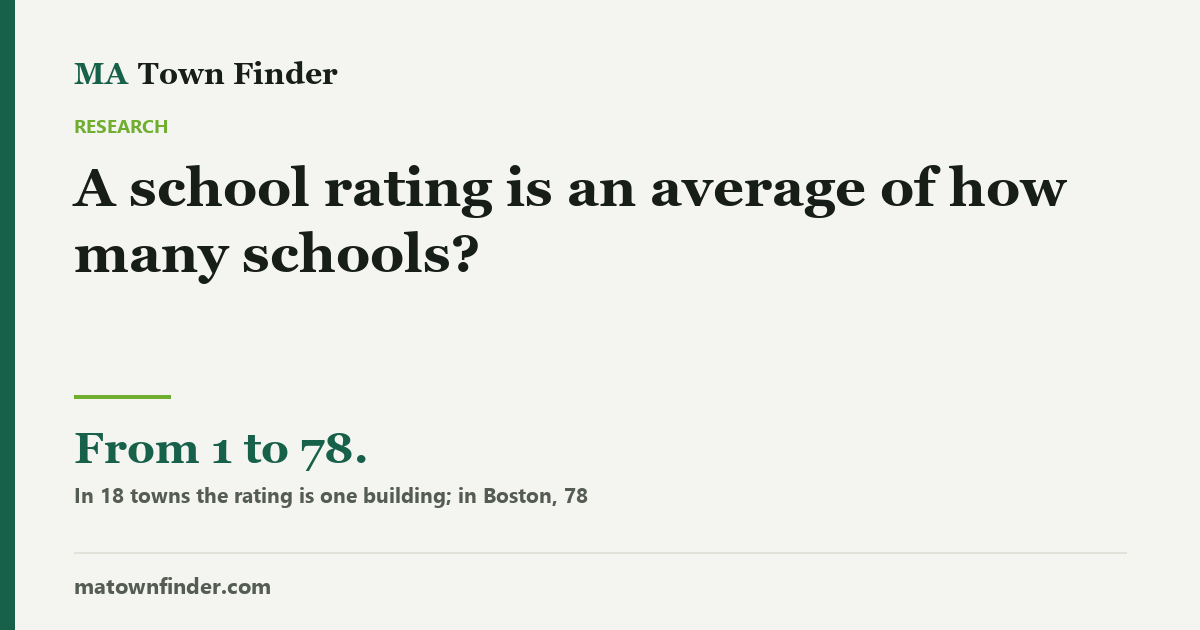
A school rating is an average. Of how many schools?
In 18 Massachusetts towns the district is one school, so the rating is a promise about the exact building your child attends. In Boston it averages 78, and those schools are not the same place — the largest elementary holds five times the smallest.
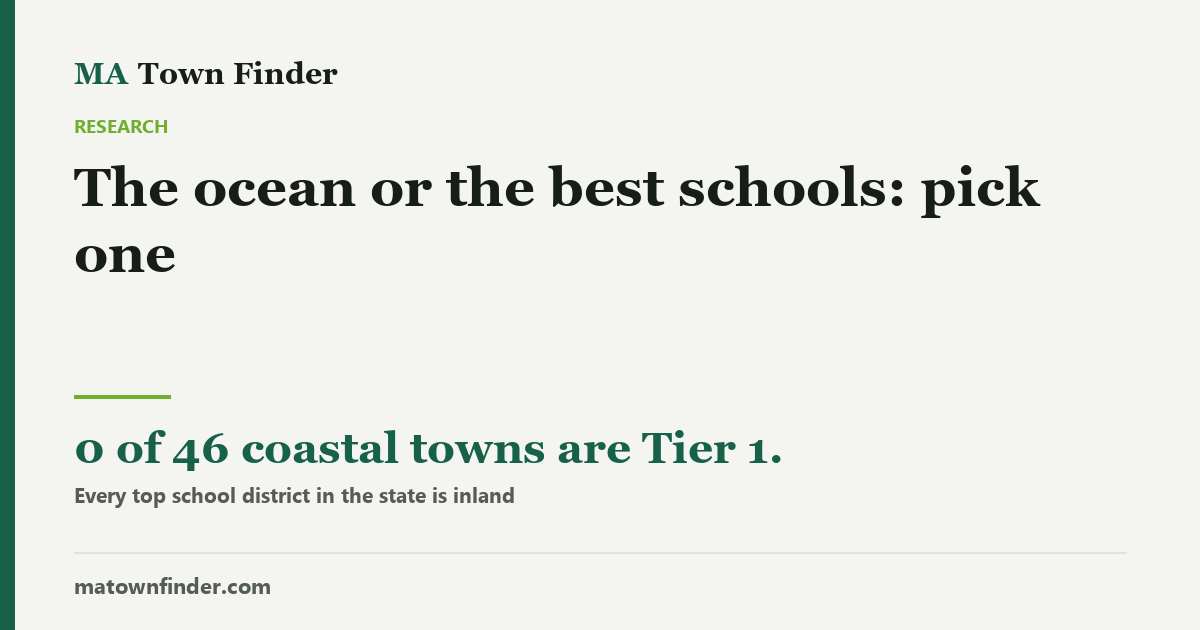
The ocean or the best schools: Massachusetts makes you choose
Every one of the state’s 23 top-tier school districts is inland. Not a single one of the 46 towns the ocean reaches has a Tier 1 district — so the house near the water and the best schools cannot be the same house.
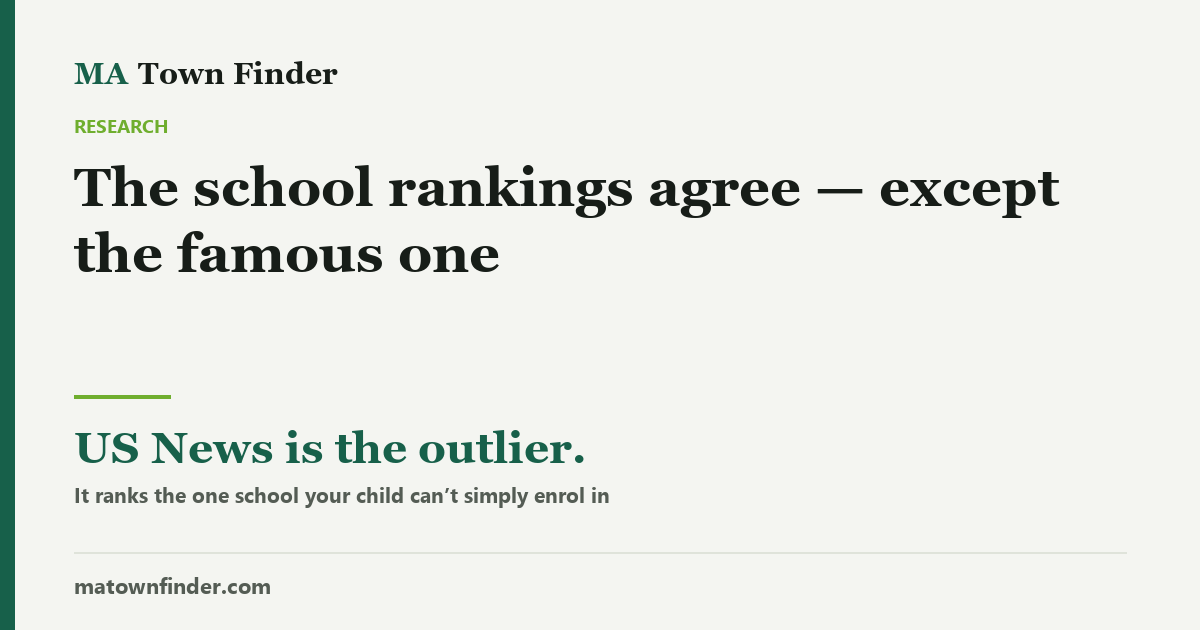
The school rankings agree — except the famous one
Niche, SchoolDigger and the state’s own MCAS figures agree almost perfectly on which Massachusetts districts are strong. US News is the outlier, and the reason matters: it ranks the best single school in a town, which in a dozen places is a charter or exam school your child can’t simply enrol in.
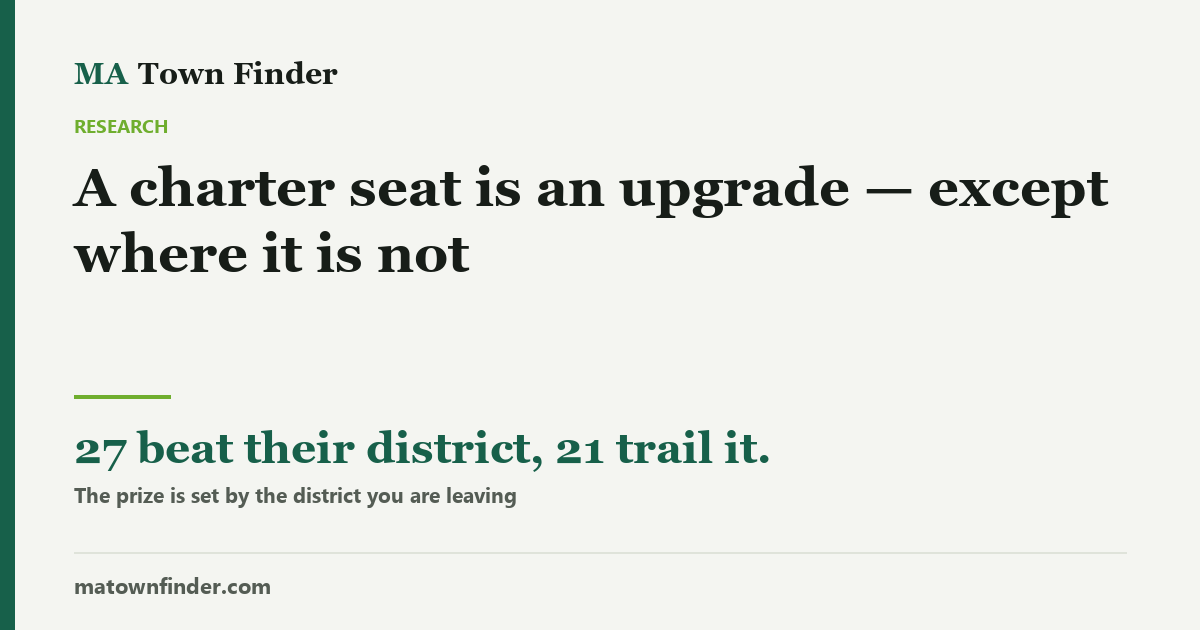
A charter seat is an upgrade — except where it is a downgrade
Across 56 Massachusetts charters, 27 clearly outscore the district they sit in and 21 clearly trail it. The gap runs from 82 points better to 64 points worse, and which one you get depends on the district you are leaving.
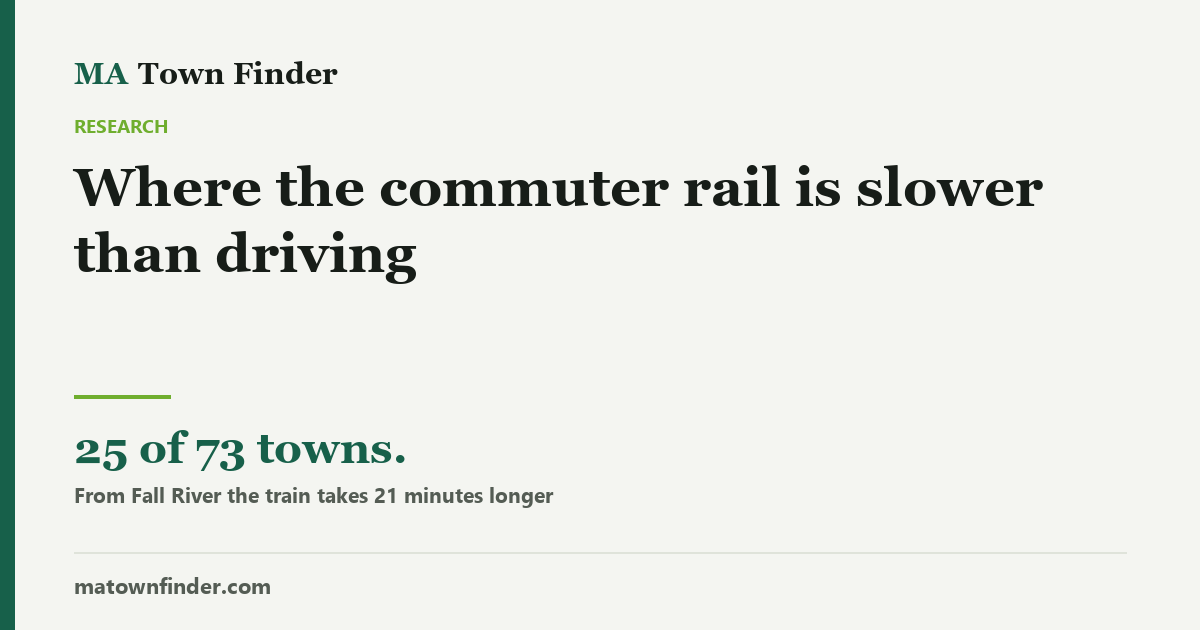
Where the commuter rail is slower than driving
Every rapid-transit town beats the car, by a median of 16 minutes. On the commuter rail only 48 of 73 do — and from Fall River the train takes 21 minutes longer than the drive.
Private school is not a plan B for a weak school district
A Tier 1 town has a median of 36 accredited private schools within twelve miles, and none has fewer than seven. Sixteen towns have none at all — every one of them Tier 3 or Tier 4.
Where can a household earning $150,000 afford good schools in Massachusetts?
Thirty-three towns as a condo, three as a townhouse, none as a four-bedroom house. Houses barely open at $200,000, and the best districts stay shut even at $300,000.
How much income do you need to buy in a good Massachusetts school district?
A household on $150,000 reaches none of them in a four-bedroom house. The same districts, bought as a condo, drop the median requirement from $300k to $176k.
What $750,000 actually buys in Massachusetts
It buys 121 of the state’s 223 towns — and not one Tier 1 school district. The number with strong schools within 45 minutes of Boston is zero.
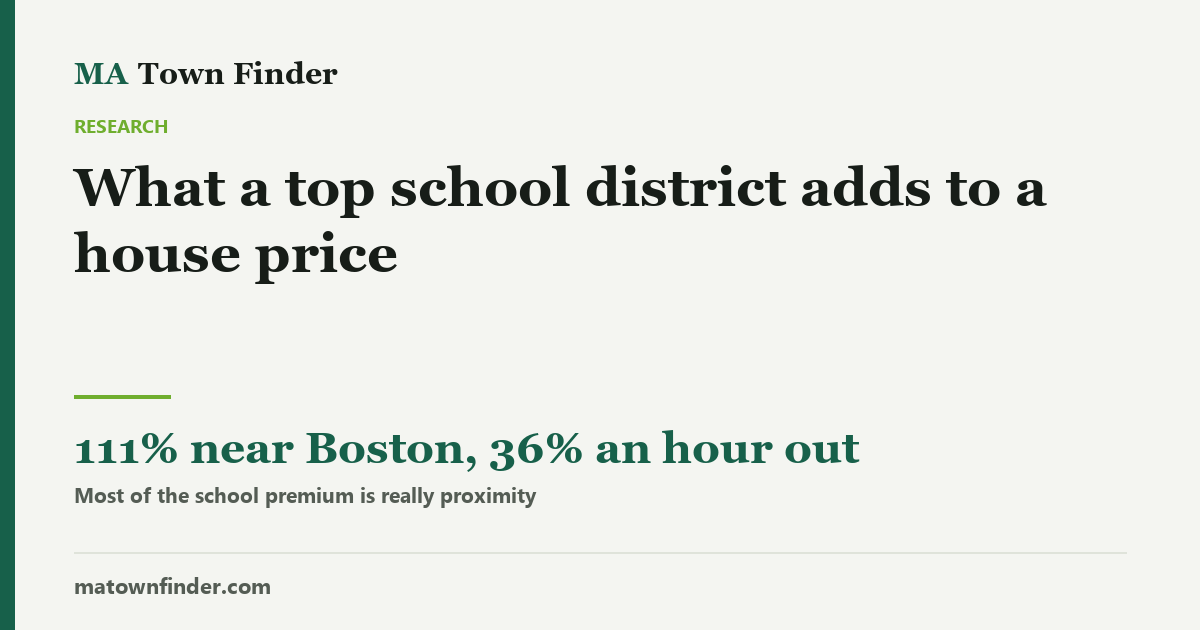
What a top school district actually adds to a house price
Close to Boston, a strong district roughly doubles the price. An hour out, the same tier costs 34% more. Most of what you pay for schools is really proximity.
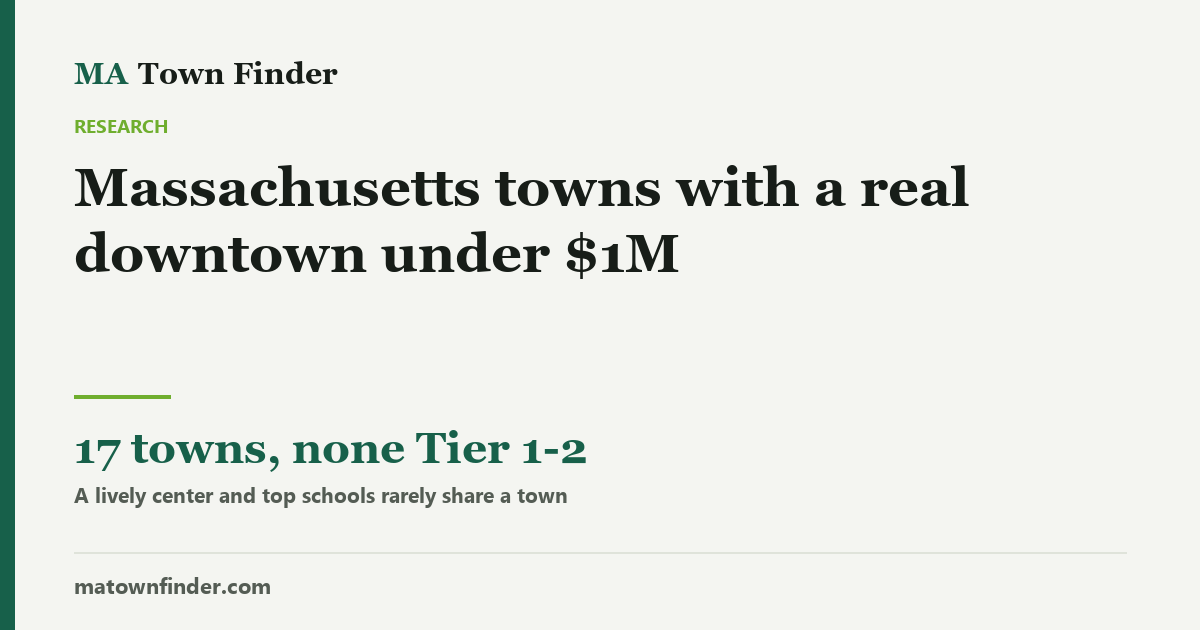
Massachusetts towns with a real downtown under $1M
Seventeen towns have a genuinely active center and a median 4BR under $1M. Not one of them has a Tier 1 or Tier 2 school district.
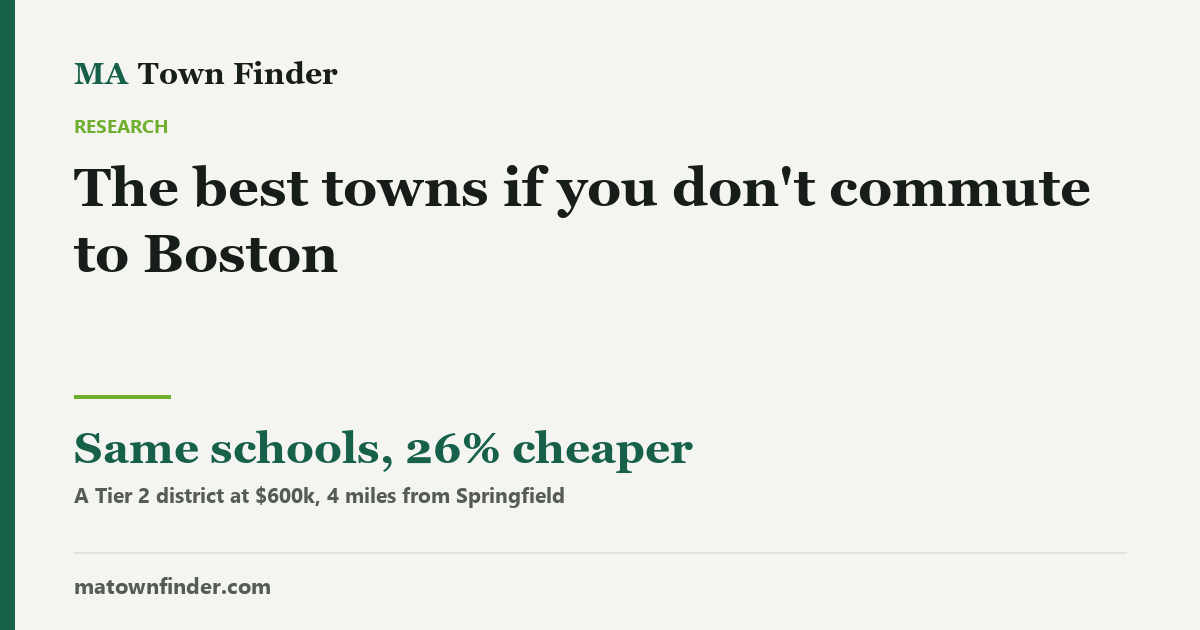
The best Massachusetts towns if you don’t commute to Boston
The same school tier costs 26% less outside the Boston commute shed. If you work in Springfield or Worcester, that premium is a discount you collect.
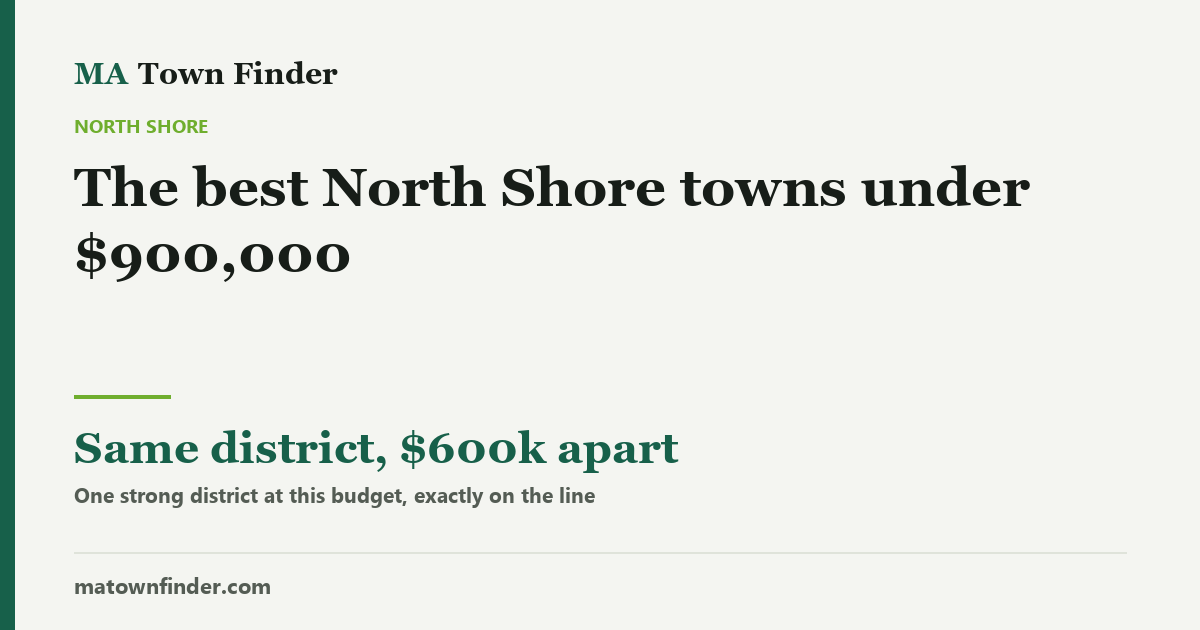
The best North Shore towns under $900,000
Seven towns clear the budget and three sit exactly on it. Only one of the ten has a Tier 1 or Tier 2 school district — and it shares that district with a town costing $600,000 more.
Charter and private school options for North Shore families
A charter seat is worth most exactly where the district is weakest — up to 82 percentile points. In one North Shore town the charter scores below the district it sits inside.
Salem vs Beverly vs Swampscott vs Marblehead: which North Shore town fits your family?
Four towns within twenty minutes of each other, and almost nothing in common once you look past the coastline. One of them nearly triples the school percentile for $125k.
Stay in Salem, move, or pay for private school?
The question I built this site to answer, priced properly. Moving to a stronger district beat paying tuition in every scenario I modeled — including with a 3% mortgage I did not want to give up.
The most compact town centers in Massachusetts — and what they cost
Compact, town-centered places are not the preserve of Cambridge and Brookline. Several score as compact as the famous names and sell for less than half.
Quiet towns, strong schools, a real Boston commute: pick two
We looked for quiet Massachusetts towns with Tier 1–2 schools within 45 minutes of Boston. Not one of them costs under $900,000.
Massachusetts college towns, compared
Forty-eight of the towns we cover have a degree-granting college. Among the ones that genuinely feel like college towns, the cheapest scores higher on culture than the dearest — at an eighth of the price.
A low property tax rate does not mean a low tax bill
Every Massachusetts tax table ranks towns by rate. We ranked all 223 by what they actually cost — and in 40% of matchups, the town with the lower rate pays the higher bill.
Rent in the district, buy in the district, or stay put and pay tuition?
You live somewhere like Salem and you want better schools. Renting into a top district is the option nobody prices — but whether it wins depends almost entirely on the mortgage you already have.
Private school vs. buying into a top school district: the real math
The housing you need either way cancels out. What is left is the district premium versus the present value of tuition — and the answer flips on how many children you have.
