Infants get one place in five at a Massachusetts child care center
A center is licensed room by room, with places recorded per age band, so what it reserves for infants can be read straight off the state’s own file. Across the 183,916 licensed center places in the 222 towns this site covers, 19.5% are infant places, and the median town licenses 2.41 preschool places for every infant place. Dover licenses 135 preschool places and nine for infants. Thirteen of those towns have no infant room in any center at all — and in Chatham there is no home-based program either.
Massachusetts licenses a child care center room by room. Each room carries an age band and a number of places, and the state publishes the result. That is an unusual amount of detail for a public file, and it means one question a lot of families ask has an answer that can be read off rather than guessed at: of the places a center is licensed for, how many are for babies.
Across the 2,649 centers in the 222 towns here, 183,916 licensed places break down as 35,872 for infants and 82,697 for preschoolers. Infants get 19.5% of the total. The median town licenses 2.41 preschool places for every infant place.
Dover licenses 135 preschool places and nine for infants
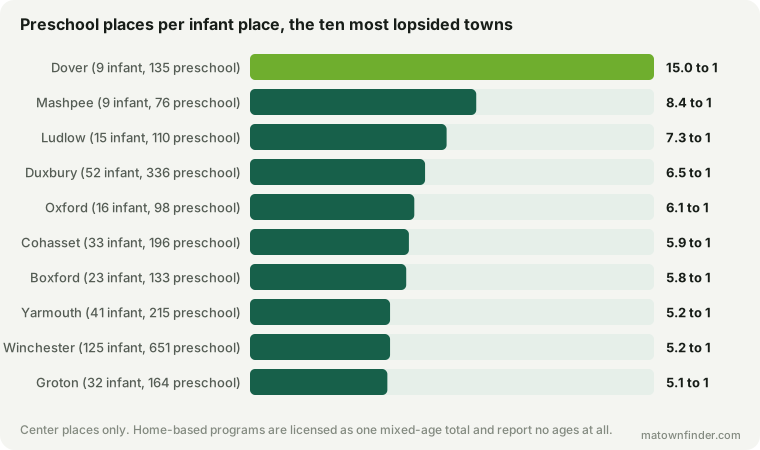
Dover is the extreme: 15 preschool places for every infant place, in a town where the median 4BR is $2M. The next four are Mashpee (8.4 to 1, $750k), Ludlow (7.3 to 1, $420k), Duxbury (6.5 to 1, $1.4M), Oxford (6.1 to 1, $500k). Read the prices along that list rather than the names: it spans most of the Massachusetts market, which is the first sign that this is not a story about what a place costs.
This piece does not explain why the split falls where it does. The licensing file records what was licensed, not the reasoning behind it, and the obvious explanations — staffing ratios, the economics of a room, what parents in a given town ask for — are not in this data and would be guesses dressed as findings. What the file does support is the shape, and the shape is consistent enough to be worth knowing before you plan around it.
It is not a price gradient
The last piece here on child care found that the kind of program near you tracks what your town costs very closely — two thirds of programs are somebody’s home in the cheapest quarter of towns and a quarter of them in the dearest. The reasonable next guess is that infant supply follows the same line.
It does not. Price and the infant share of center places correlate at r = 0.11, which is nothing. The share sits near a fifth in the second, third and dearest quarters alike.
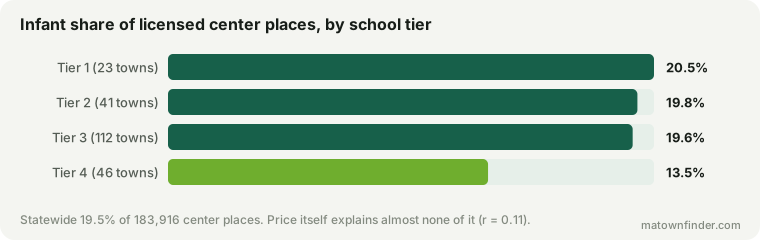
The one group that separates is the bottom school tier at 13.5% against 20.5% in the top — and since Tier 4 towns are largely the cheapest ones, that is the same bottom-end effect the price quartiles show and not a second finding. Everywhere above it, the ratio is roughly the same wherever you look.
Thirteen towns license no infant room at all
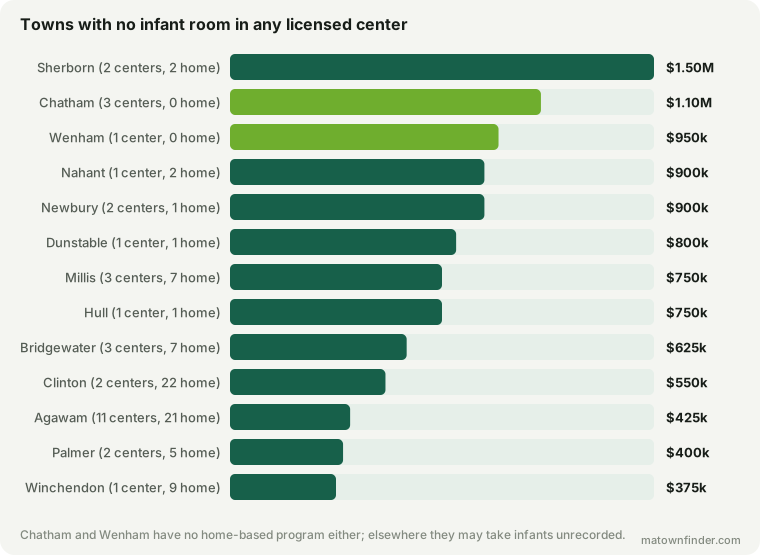
Thirteen towns license no infant places in any center. The list starts at Sherborn ($1.5M) and runs down to Winchendon ($375k), which again is not a price story — it is mostly a story about small towns with one or two centers, where a single room either exists or does not.
For most of those thirteen the honest claim stops at “no center room”. Home-based programs take infants and report no ages at all, so a town with a dozen of them may be well supplied in a way this file cannot see. Two towns leave no room for that reading: Chatham and Wenham have no home-based programs either. In those two there is no licensed infant care of any kind.
What this cannot tell you
The blind spot is large and worth stating in numbers rather than in a hedge. The towns here hold 5,276 home-based programs licensed for 42,295 places, and not one of them reports an age breakdown — the state licenses them as a single mixed-age total. Every figure above is therefore a statement about centers, and a floor rather than a count where infant supply is concerned.
Two further limits. Licensed capacity is the maximum a program may operate to, not its enrolment and not its vacancies — a town can be licensed for fifty infant places and have none free. And there is no denominator here: nothing in this data says how many babies live in the town, so none of this is a claim about whether supply meets demand. It is a claim about what was licensed.
How to use this
- Ask about infants specifically, and early. A town with plenty of child care can still be a town with 2.41 preschool places per infant place. The count you were told is probably the preschool count.
- Count the home-based programs too. They are two thirds of all programs statewide, they take infants, and they are invisible in every age-band figure including this one.
- Do not read the price of the town as a signal. On this measure it is not one. Sherborn at $1.5M and Winchendon at $375k are on the same list.
How this was measured
Licensing records come from the Massachusetts Department of Early Education and Care, via the state’s Education-to-Career research hub. Programs listed as expired are excluded. A town with no center at all is excluded rather than counted as a zero, which leaves 222 of the municipalities this site covers.
Boston’s neighborhoods are left out. A child care license records the postal city, so thirteen of them carry their own programs while the other five sit inside the Boston row — a per-town median over that mixture would be comparing two different kinds of unit. Prices and school tiers are this site’s own; see the methodology, or download the tables. Figures as of September 11, 2026.