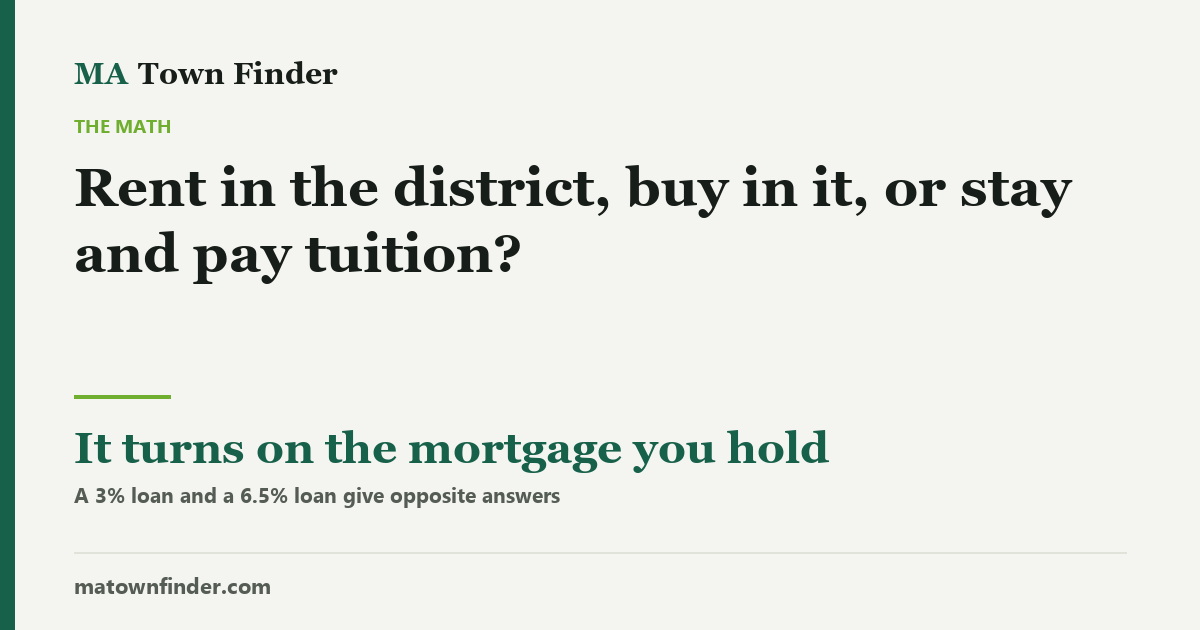
Rent in the district, buy in the district, or stay put and pay tuition?
You live somewhere like Salem and you want better schools. Renting into a top district is the option nobody prices — but whether it wins depends almost entirely on the mortgage you already have.
You live somewhere like Salem — a decent town, Tier 3 schools on our editorial scale — and you want something stronger for your kid. Almost everyone frames this as two choices: buy into a top district, or stay and pay tuition.
There is a third: rent in the top district. Residency is what buys you a seat in a public school, and a lease establishes residency exactly like a deed does. Nobody prices it, so we did.
The answer turns out to hinge on one thing almost no article asks: what mortgage do you already have?
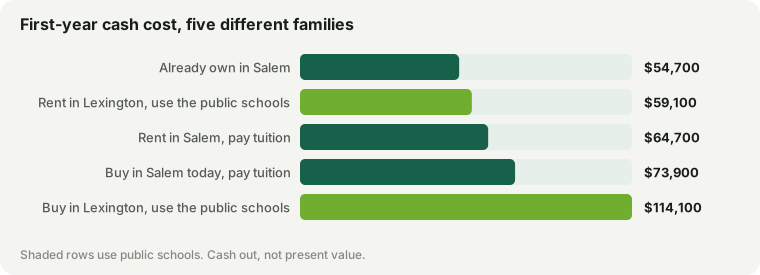
Five families, not three
“Stay put” and “buy in Salem today” are not the same family. Someone who bought before rates rose is carrying a payment that no longer exists in the market. So we split them out. Our existing owner is illustrative: 3.25% on $300k still owed.
| Option | Estimated first-year cash outlay | Schools |
|---|---|---|
| Already own in Salem — keep the mortgage, pay tuition | ≈$55,000 | private |
| Rent in Lexington, use the public schools | ≈$60,000 | public |
| Rent in Salem, pay tuition | ≈$65,000 | private |
| Buy in Salem today, pay tuition | ≈$74,000 | private |
| Buy in Lexington, use the public schools | ≈$114,000 | public |
First-year cash out of pocket — not a full economic comparison. Owning counts mortgage payment, that town’s FY2026 property tax, insurance and 1% of value for maintenance; renting counts rent plus renter’s insurance. Tuition assumed at $25,000 for one child. All figures rounded to the nearest $5k because the inputs are estimates.
Two things fall out. First, an owner with a small, cheap mortgage can stay put and pay tuition for less than renting in Lexington — roughly ≈$55,000 against ≈$60,000. Second, for anyone without that mortgage, renting in Lexington beats buying there by something like ≈$55,000 in year one, and also beats renting in Salem and paying tuition.
The mortgage you have decides it
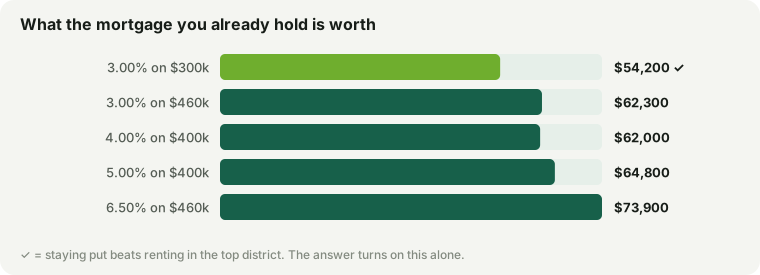
This is the whole ballgame, so here it is directly: the same Salem house, the same $25,000 tuition, varying only the loan you are already carrying — against ≈$60,000 to rent in Lexington.
| Your existing Salem mortgage | First-year cash + tuition | vs. renting in Lexington |
|---|---|---|
| 3% on $300k remaining | ≈$54,000 | Staying is cheaper |
| 3% on $460k remaining | ≈$62,000 | Renting is cheaper |
| 4% on $400k remaining | ≈$62,000 | Renting is cheaper |
| 5% on $400k remaining | ≈$65,000 | Renting is cheaper |
| 6.50% on $460k remaining | ≈$74,000 | Renting is cheaper |
The cheap mortgage is worth roughly ≈$20,000 a year against today’s rate — and it flips the verdict. Note how narrow the band is: a 3% mortgage with $460k still owed lands close enough to Lexington rent that our estimates cannot separate them. It is the balance as much as the rate. Either way, no “rent vs. buy” piece that ignores what you already pay is worth much.
Ten years, not one
A first year is a cash-flow snapshot, not a verdict. Owning builds equity — in year one, buying that $1.35M Lexington home pays down about $12,071 of principal, which is saving, not spending. And appreciation, which nobody can promise, dominates everything over time.
So here is the present value of 10 years, including the down payment, 2% closing costs, maintenance, 5% to sell, and the equity and appreciation you get back at the end — discounted at 4%, which also prices the return you forgo on a down payment. Rent grows 3% a year.
| If housing appreciates… | Own Salem + tuition | Buy Salem today + tuition | Rent Lexington | Buy Lexington |
|---|---|---|---|---|
| 0% a year | $600,000 | $745,000 | $550,000 | $1,007,000 |
| 3% a year | $474,000 | $618,000 | $550,000 | $709,000 |
| 5% a year | $368,000 | $513,000 | $550,000 | $462,000 |
10-year present value of everything you pay, minus what you get back at sale. Private-school options include $25,000/yr for one child, K–12, inflating 4%.
Notice the last row. At 5% appreciation, buying in Lexington overtakes renting there — the asset does the work that the cash-flow table cannot see. At 0% it is not close. We are not going to tell you which one happens; that is the bet you are actually making when you buy.
How many children, and how many years left
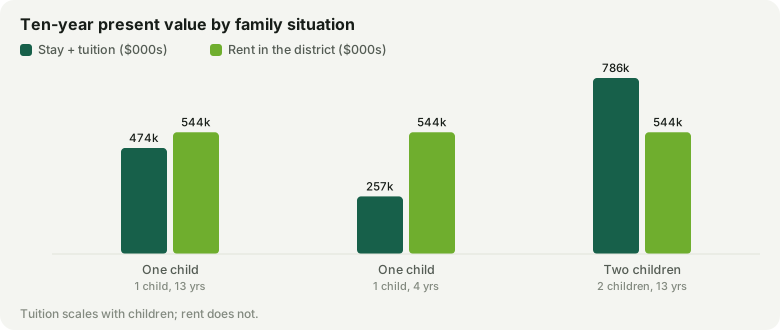
Rent is the same whether you have one child or three. Tuition is not. For our existing Salem owner over 10 years:
| Family | Tuition (PV) | Stay + tuition | Rent Lexington | Cheaper |
|---|---|---|---|---|
| One child entering kindergarten | $313,000 | $474,000 | $550,000 | Stay put |
| One child entering ninth grade | $96,000 | $257,000 | $550,000 | Stay put |
| Two children entering elementary | $625,000 | $786,000 | $550,000 | Rent Lexington |
A child entering ninth grade needs only four years of tuition, and staying put wins easily — about ≈$295,000 cheaper than renting in Lexington. Two children entering elementary reverses it completely: $625,000 of tuition is more than the entire cost of renting in Lexington for 10 years, so the district seat wins by roughly ≈$235,000. Tuition scales with the number of children; a lease does not. That one fact decides more of these cases than the mortgage does.
Where renting looks cheaper than buying
Across Tier 1 and Tier 2 towns, these show the widest first-year gap between renting a 3-bedroom and buying one. Treat them as approximations, and check real listings — family-sized rentals in these towns are genuinely scarce.
| Town | Tier | 3BR price (est.) | Rent /mo (HUD) | First-year cash gap |
|---|---|---|---|---|
| Weston | 1 | $1.75M | $3,570 | ≈$100,000 |
| Concord | 1 | $1.4M | $3,673 | ≈$75,000 |
| Lincoln | 1 | $1.5M | $4,453 | ≈$75,000 |
| Dover | 1 | $1.3M | $3,800 | ≈$65,000 |
| Wellesley | 1 | $1.45M | $4,840 | ≈$60,000 |
| Belmont | 1 | $1.25M | $3,740 | ≈$60,000 |
| Sudbury | 1 | $1.15M | $3,453 | ≈$60,000 |
| Winchester | 1 | $1.25M | $3,843 | ≈$60,000 |
| Lexington | 1 | $1.35M | $4,963 | ≈$55,000 |
| Wayland | 1 | $1.1M | $3,590 | ≈$55,000 |
| Needham | 1 | $1.25M | $4,273 | ≈$55,000 |
| Brookline | 1 | $1.35M | $4,953 | ≈$50,000 |
| Sherborn | 1 | $1.05M | $3,483 | ≈$50,000 |
| Cohasset | 2 | $1.1M | $3,643 | ≈$50,000 |
| Carlisle | 1 | $1.05M | $3,513 | ≈$50,000 |
| Newton | 1 | $1.25M | $4,647 | ≈$45,000 |
| Manchester-by-the-Sea | 2 | $1.05M | $3,223 | ≈$45,000 |
| Hingham | 2 | $1.05M | $3,670 | ≈$45,000 |
| Cambridge | 2 | $1.25M | $4,700 | ≈$40,000 |
| Milton | 2 | $950k | $3,180 | ≈$40,000 |
First-year cash difference only — not lifetime savings. As the table above shows, appreciation can close or reverse these gaps, and the rental benchmark is not the same property as the house being priced. The largest gaps sit in the most expensive towns, where a 6.5% mortgage on a $2M house simply costs a great deal to carry.
What this comparison is not
- It is not the same property. The purchase figure is a representative 3-bedroom ownership estimate; the rent is HUD’s 3-bedroom benchmark — a 40th-percentile, standard-quality gross rent that includes tenant-paid utilities. It may be a smaller, older, utilities-included apartment rather than the townhouse you would have bought. Part of the gap is that difference, not pure savings.
- Renting has costs we did not model: broker fees, moving, deposits, and — the real one — a landlord who sells and moves your family mid-school-career. A deed cannot be non-renewed.
- The towns are not interchangeable. Salem has commuter rail; Lexington does not, and we model a 38-minute drive. Depending on where you work, that swing can eat the entire advantage before schools enter the argument.
- “Better schools” is a claim, not a fact. Our tiers are editorial groupings; Lexington has stronger conventional metrics, but that does not mean every school there suits every child, or that a district seat substitutes for a specific private school with a specific program. This piece is for families who consider Lexington public schools an acceptable alternative to their private option.
- Tuition varies enormously. $25,000 is a statewide-average stand-in. The real range near Lexington runs from parochial schools well under $15k to independent day schools past $45k, before fees, transport and aid.
The defensible conclusion
For a family entering today’s market — no existing low-rate mortgage, one child, and access to a suitable rental — renting in a highly rated district plausibly produces the lowest first-year cash outlay, and beats both buying there and paying tuition elsewhere.
If you already own at 3%, compare against your actual payment, not this article. A small balance at a pandemic-era rate can beat any rent in a top district, and staying put with tuition becomes the better answer — especially with one child, or a teenager with only a few years of school left. A larger balance at the same rate is close enough that the choice stops being financial.
The mechanism is simple enough: today’s mortgage rates raised the monthly cost of buying much faster than they raised existing rents, widening the short-term gap between renting and owning. Whether that gap persists depends on appreciation, which nobody knows.
The move that survives all of this: rent in the district for a year or two, find out whether the town is what you hoped, and buy from the inside with far better information than an open house gives you.
Rent data: HUD FY2027 Small Area Fair Market Rents (40th percentile), by ZIP (HUD). Prices, tuition and commute times are estimates — see our methodology. Estimates for comparison, not financial advice.