Peabody is America’s hottest ZIP code. Its tax bill is the real story.
Realtor.com named 01960 the hottest ZIP code in the country and the coverage gave four reasons: affordable, a revived downtown, low taxes, good highway access. Checked against the data, three hold — and the tax one is far stronger than reported. Peabody’s estimated bill is the second lowest of the 18 North Shore towns, less than half what Wenham or Topsfield pay. The fourth reason is the polite version of something the coverage does not mention: there is no train.
Realtor.com has named 01960 — Peabody — the hottest ZIP code in the United States for 2026, and it has been picked up by the Boston Globe, Banker & Tradesman and most of the local press. It is the third time the town has made the list.
Nothing here disputes the ranking. It is built from listing views and days on the market, which measure demand, and this site holds neither. What this site does hold is what a buyer arriving because of the headline would actually be buying — so this checks the four reasons the coverage gives against the numbers. Three of them hold up. One is much stronger than reported. The fourth is a polite way of describing something the coverage does not mention at all.
1. “Low taxes” — much stronger than reported
The coverage describes Peabody as having a low tax rate for the North Shore, which is true: at $9.47 per $1,000 it is the 5th lowest of the 18 towns up there. But the rate is not what anyone pays. The bill is, and the bill is a better story.
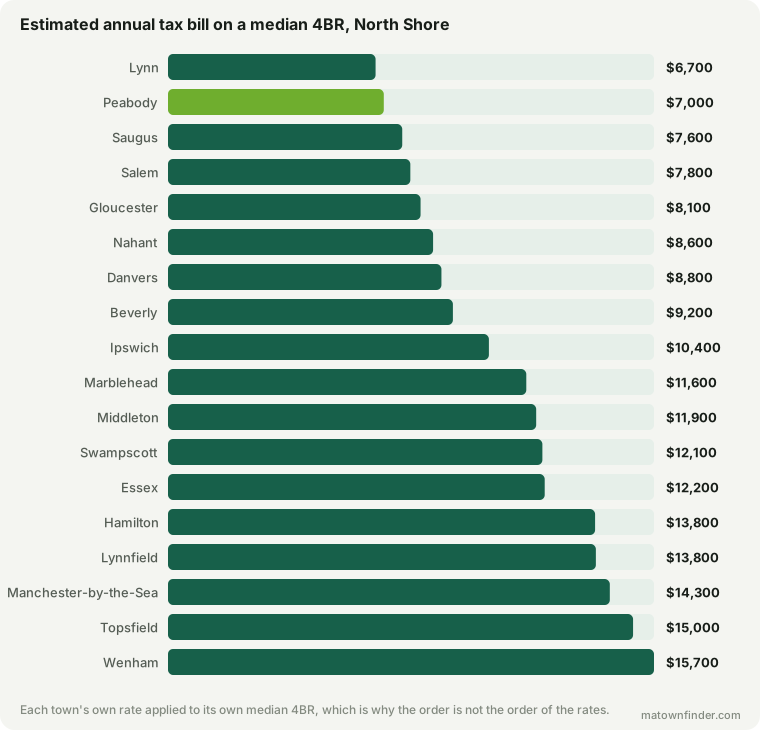
Peabody’s estimated annual bill on a median 4BR is about $7,000 — the second lowest of the 18 North Shore towns, behind only Lynn. Against Topsfield at $15,700 it is less than half. Against Wenham, a short drive away, it is a saving of $8,200 a year, every year, for as long as you own the house.
That is the part of the story worth carrying away, and it is a specific case of something this site has written about at length: rate tables mislead, because the bill is rate times value and the values vary far more than the rates do.
2. “Affordable” — true, but relative
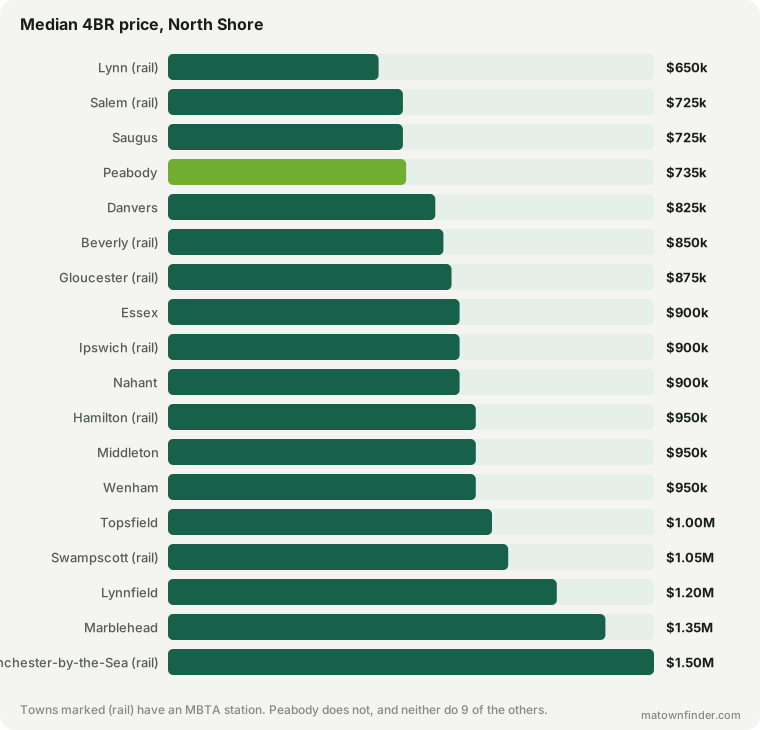
At $735k for a median 4BR, Peabody is the 4th cheapest of the 18 North Shore towns. Widen the frame to every Massachusetts town within 45 minutes of Boston and it is 11th of 49. Cheaper than most of the region, then, but comfortably mid-pack against the commute it offers — this is not an undiscovered bargain, and the ranking is partly why.
3. “A revived downtown” — supported
This site scores every town on how compact and town-centred its built environment is, from car-dependent sprawl to a continuous walkable core. Peabody scores 7 out of 10, which clears the bar this site uses for a genuine centre, with an energy score of 7. That is a real centre by our own measure rather than a press release, and it is not something most towns at this price have.
4. “Highway access” — the missing train
Here is the one the coverage does not quite say. Good highway access is what you praise when there is no alternative to driving. Peabody has no MBTA station. Of the 18 North Shore towns, 8 have commuter rail — Beverly, Gloucester, Hamilton, Ipswich, Lynn, Manchester-by-the-Sea, Salem, Swampscott — and Peabody is not among them.
The cost shows up in the commute. Peabody is 13 miles from downtown Boston and a modelled 45 minutes door to door, because all of it is road. Wilmington sits 2 miles further from Boston and still gets in quicker, at 44 minutes, because it has a station. If one of you commutes into the city daily, that is the single largest thing the headline does not tell you, and it is worth testing against your own journey before anything else on this page.
The thing nobody is mentioning
Peabody’s school district is Tier 3 on this site’s scale, sitting at the 26th percentile on the state’s own MCAS achievement measure. Its growth percentile — how far it moves children, which we would argue is the better number — is 48th, meaningfully better than its raw scores and still middling.
None of that makes it a bad place to live, and a low tax bill plus a walkable centre is a genuinely good combination. But “hottest ZIP code in America” will be read by a lot of families as a verdict on the whole package, and the schools are the part of the package the ranking does not measure at all.
Is it already priced in?
Partly, and less than you might expect. Peabody rose 33.3% between 2019 and 2022 against a North Shore median of 35.8% — slightly below its neighbours, not ahead of them — and has added 11.3% since. So the town has not historically outrun the region. Being the hottest market is a statement about demand this year, not about a decade of appreciation already banked, and the two get confused constantly.
How to use this
- The tax bill is the real edge. It is durable, it compounds, and unlike the ranking it will still be true next year.
- Check your own commute first. No station means the modelled 45 minutes is a drive, and drives get worse.
- Look at the schools yourself. The Peabody page carries the state’s figures, the district’s schools and the private and charter options nearby.
- Compare rather than assume. Peabody against Salem and against Danvers are the two matchups most buyers here are actually weighing.
How this was measured
The ranking itself is Realtor.com’s, reported by the outlets linked above; the listing-level figures in that coverage are theirs and are not reproduced here. Everything else is this site’s own: median 4BR prices calibrated to the Zillow Home Value Index and Redfin, FY2026 residential tax rates from municipal sources with the bill computed as rate times each town’s own median 4BR, modelled door-to-door commute times, MCAS figures from the state, and the compactness score from the vibe model. The North Shore is the MAPC task-force roster rather than a line we drew.
Prices are estimates for comparison, not appraisals, and a tax bill computed from a modelled median is indicative rather than what any individual owner pays. See the methodology, or download the tables. Figures as of September 17, 2026.