Private school vs. buying into a top school district: the real math
The housing you need either way cancels out. What is left is the district premium versus the present value of tuition — and the answer flips on how many children you have.
Every Massachusetts family with a kid and a budget eventually asks some version of this: do we pay up for a house in a top public-school district, or buy somewhere cheaper and write tuition cheques?
Most attempts to answer it are wrong in the same way — they set a house price against a tuition bill, as though you could otherwise live nowhere. You need housing in both worlds. The only thing that differs is the premium: what the better district costs you on top of the house you would have bought anyway, and how much of that premium you never get back.
The right equation
Housing appears on both sides, so it cancels. What is left:
| Buy into the top district | Buy cheaper + pay tuition |
|---|---|
| Extra mortgage interest on the premium | Tuition, inflating ~4% a year |
| Extra property tax, insurance, maintenance | Fees, transport, activities |
| Return forgone on a bigger down payment | Less any financial aid |
| − equity and appreciation recovered at sale | − nothing. Tuition buys no asset. |
That last line is the one people skip. A mortgage payment is part expense, part forced savings; tuition is entirely consumed. So we do not count the premium as a cost — we count the non-recoverable part of it, and we compare present values, because a dollar in year twelve is not a dollar today.
The assumptions, in full
- 20% down, 6.5% 30-year fixed
- Each town’s real FY2026 property tax rate, growing 2.5%/yr (Prop 2½)
- Maintenance 1% of value per year; insurance $175/mo; both inflating 3%
- House appreciates 3%/yr; 5% to sell
- Everything discounted at 4% — which also prices the opportunity cost of the larger down payment
- Tuition inflates 4%/yr; comparisons are like-for-like 4BR houses
What the premium actually is
Take Lexington — $2.05M for a 4-bedroom, one of 23 towns in our top school tier. Owning it for 10 years costs $1,025,673 you never get back in today’s money, after you sell and pocket the equity and appreciation.
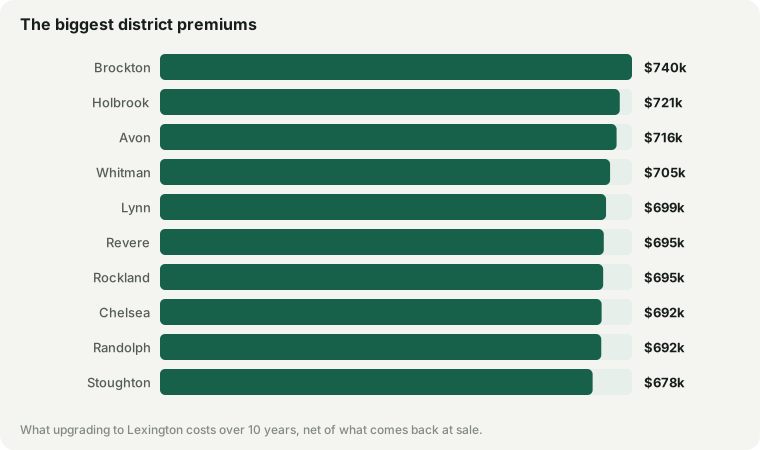
Do the same for Brockton at $550k, and the difference — the true cost of the school district, not the sticker gap — is $739,712 over 10 years. That is the number tuition has to beat. Not the $1.5M price difference.
The answer depends entirely on your family
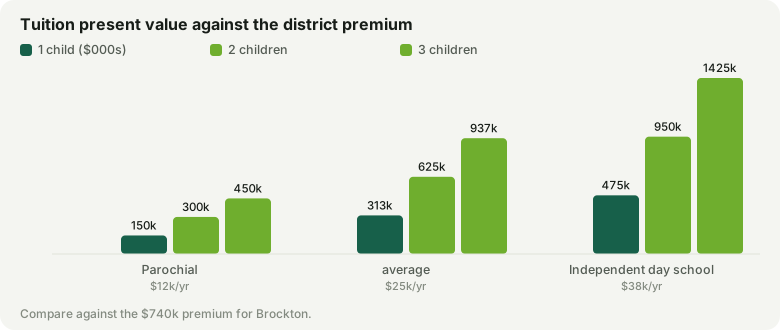
Here is why no article should give you a single verdict. The premium is paid once per household. Tuition multiplies by child and by year. Same two towns, same premium of $739,712 — and the answer flips:
| Tuition (per child, per year) | 1 child, K–12 | 2 children | 3 children |
|---|---|---|---|
| Parochial / Catholic elementary | Private | Private | Private |
| Statewide private average | Private | Private | Buy into Lexington |
| Independent day school | Private | Buy into Lexington | Buy into Lexington |
One child? Private wins at any realistic tuition. Three children at an independent day school? The Lexington house is the cheaper choice by a wide margin — the free public school it comes with is doing $685,288 of work.
And on how long you stay
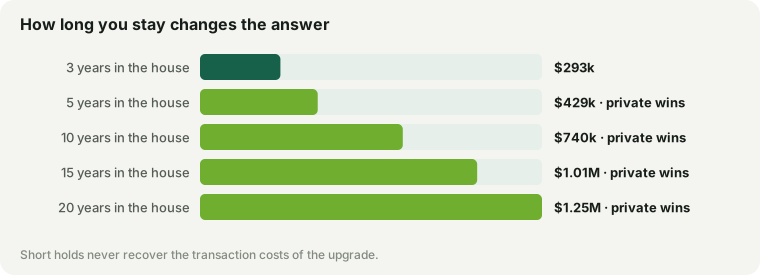
Buy and sell inside a few years and transaction costs eat you alive; stay long enough and the premium keeps compounding. For one child at the statewide average tuition (PV $312,500):
| Years in the house | Non-recoverable premium | Cheaper choice |
|---|---|---|
| 3 years | $293,287 | Buy into Lexington |
| 5 years | $429,435 | Brockton + private |
| 10 years | $739,712 | Brockton + private |
| 15 years | $1,011,001 | Brockton + private |
| 20 years | $1,247,477 | Brockton + private |
At a three-year hold the Lexington house wins even for an only child: you have not owned it long enough to recover the cost of buying and selling. Anyone quoting this comparison without naming a holding period is guessing.
When the towns are closer together
Brockton and Lexington are extremes. Take Reading instead — Tier 2 schools, $975k, a 41-minute commute. The premium drops to $539,576 over 10 years. One child at average tuition ($312,500) still favours staying put and paying. Two children at an independent day school ($950,000) does not come close — buy in Lexington. A single child entering ninth grade, with only four years of tuition left ($146,154 even at $38k), is the easiest private-school case there is.
The 20 biggest premiums
Commutable towns where buying into Lexington instead would cost you the most over 10 years — with the cheapest real private school near each, rather than a blended statewide average.
| Town | 4BR | Lexington premium (10y) | Nearest cheap private option | Private schools |
|---|---|---|---|---|
| Brockton | $550k | $739,712 | Trinity Catholic Academy | 11 |
| Holbrook | $550k | $737,332 | St. Bridget | 12 |
| Avon | $550k | $731,184 | Trinity Catholic Academy | 11 |
| Whitman | $600k | $706,495 | St. Bridget | 10 |
| Rockland | $600k | $703,358 | St. Bridget | 14 |
| Lynn | $650k | $699,029 | St. Pius V Elementary | 14 |
| Revere | $675k | $695,485 | Immaculate Conception Elementary | 11 |
| Chelsea | $650k | $692,115 | St. Anthony Elementary | 13 |
| Randolph | $650k | $691,529 | St. John the Evangelist Elementary | 14 |
| Abington | $650k | $684,321 | St. Bridget | 11 |
| Stoughton | $675k | $678,021 | St. John the Evangelist Elementary | 13 |
| Malden | $700k | $668,449 | Cheverus Elementary | 12 |
| Billerica | $700k | $667,124 | Immaculate Conception | 12 |
| Weymouth | $725k | $664,747 | Sacred Heart Elementary | 16 |
| Peabody | $735k | $664,343 | St. John the Baptist Elementary | 14 |
| Saugus | $725k | $662,787 | St. Mary of the Annunciation School | 13 |
| Tewksbury | $700k | $661,129 | Saint Augustine | 14 |
| Everett | $700k | $660,750 | St. Anthony Elementary | 12 |
| Salem | $725k | $660,434 | St. Pius V Elementary | 13 |
| Hull | $750k | $648,303 | South Boston Catholic Academy | 18 |
Premium = present value of the non-recoverable cost of owning the Lexington house for 10 years, minus the same for this town. Tuition figures are estimated ranges by school type — see our methodology.
Six things this model still cannot tell you
- Admission is not a purchase. Buy the house and the district must enrol your child. A private school can reject them, run out of seats, fail to support a learning need, or cut aid. That asymmetry does not appear anywhere in the arithmetic above, and for many families it settles the question on its own.
- You still pay property tax. Going private does not refund the school share of your bill, and it is not optional. Only the difference in tax between two towns belongs in this model — which is how we have treated it.
- Median prices are not identical products. A $550k 4-bedroom in Brockton and a $2.05M one in Lexington differ in lot, age, condition and commute. Some of the premium buys house, not schooling.
- The cheaper town is cheaper for many reasons. Commute, transit, services, walkability, flood risk and expected appreciation are all in that price gap. Attributing the whole thing to the school system overstates what you are buying.
- A ranking is not a causal claim. Selective schools enrol selected families. Raw score gaps between schools narrow — and sometimes reverse — once you adjust for who enrols. Compare fit and services for your child, not league tables.
- Appreciation is a bet. We assume 3%. If top-district housing outruns that, the premium shrinks or vanishes; if it stalls, the premium is worse than shown. We are pricing carrying costs, not forecasting the market.
The defensible conclusion
Buying cheaper and paying tuition wins when the present value of tuition is less than the non-recoverable cost of the district premium — which is true for one child at almost any tuition, and false for three children at an independent day school. It is not true simply because the house costs less.
The practical read: fewer children and fewer remaining school years push you toward private; more children, younger, and a long stay push you toward the district. If you have one kid starting ninth grade, the maths is barely close. If you have three in nappies and plan to die in the house, buy the district.
Estimates for comparison, not financial advice. Prices and tuition are modeled — verify with an agent and with each school.