One in six towns has a rival that beats it on price, commute and schools. It is rarely nearby.
Ask of every Massachusetts town whether another is at least 10% cheaper, 5 minutes closer to Boston and 5 points higher on MCAS — and allow for the coast — and 36 of 222 are beaten on every count. But the rival is rarely nearby. Within 15 miles, 12 towns are beaten; within 5 miles, none. Locally the market prices these three things almost exactly. The better deals sit a median 23 miles away, a region over from where most families look.
Most of the writing on this site takes one trade-off at a time: what a strong district adds to a price, what distance takes off it. This one takes the three things a family weighs most and asks the bluntest possible question of every town at once: is there another town that is cheaper, closer to Boston, and has higher test scores?
If there is, the town is beaten on every count. On these three numbers, a strictly better option exists. The answer turns out to depend almost entirely on how far you are willing to look.
Anywhere in the state: one town in six
Counted with no margins at all, 137 of the 222 towns are beaten by something — but a rival a dollar cheaper and a minute closer is noise, not a finding. So a rival here has to be at least 10% cheaper, 5 minutes closer and 5 points higher on the share of students meeting expectations: differences a buyer would notice, and larger than the error in any of the three figures.
On those terms, 49 towns are beaten. But the three measures leave something out, and the pattern gives it away: 25 of the 46 coastal towns are beaten, against 24 of 176 inland — 54% against 14%. People pay for the water, and the water is not one of the three. Require any rival to be at least as coastal as the town it beats, and 36 are left — about one town in six.
Within reach: almost none
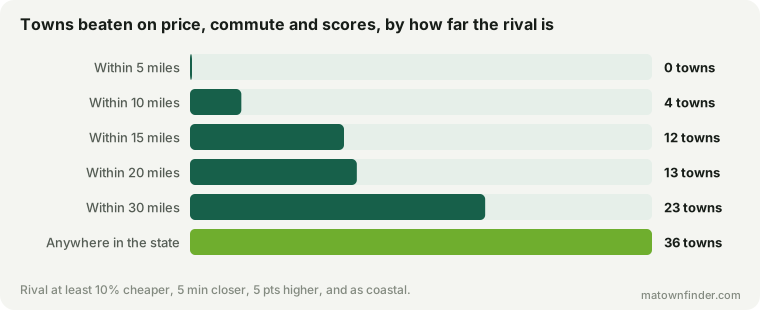
Now limit how far the rival may be. Within 15 miles, 12 towns are beaten. Within 10, 4. Within 5 miles, none. For the beaten towns, the nearest rival is a median of 23 miles away.
That is the finding, and it is more interesting than a list of bad buys. Locally, the market prices price, commute and schools close to exactly: a town is almost never beaten by the towns around it. The better deals do exist — but a region away, outside the radius most families search. That is why they last. A buyer looking in one corner of the state never sets it beside another.
The twelve that a local search would find
These are the towns with a rival within 15 miles, which is where the finding is most useful, because a family searching one could plausibly look at the other.
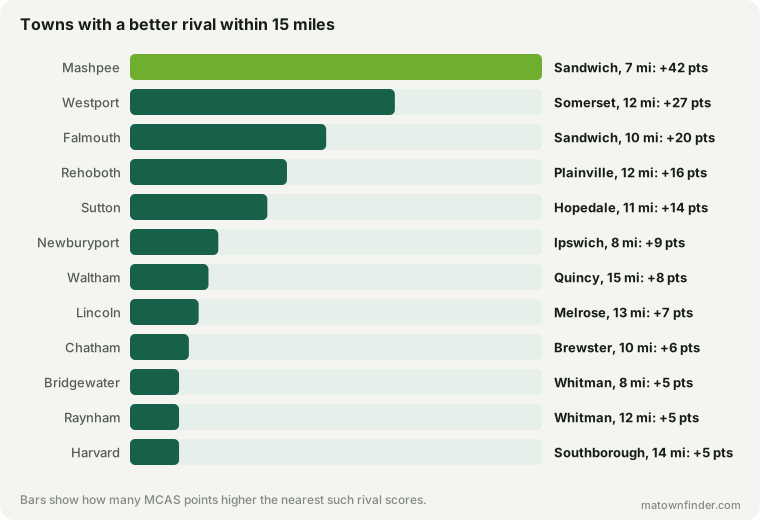
The starkest is Mashpee: Sandwich, 7 miles away, is $137k cheaper for a typical three-bedroom home, 6 minutes closer to Boston, and 42 points higher on the share of students meeting expectations. Five of the twelve are coastal, and two are Tier 1 districts: Lincoln (beaten by Melrose) and Harvard (beaten by Southborough).
And the ones only a statewide list would name
The most-beaten town in the state is West Newbury, with 21 rivals — and the nearest of them, Chelmsford, is 25 miles away. That is the pattern in miniature: a town that looks badly priced on a statewide table and perfectly reasonably priced to anyone actually shopping there.
What “beaten” does not mean
It does not mean a bad place to live, or a town that is overpriced in any sense its residents would recognise. It means its buyers are paying for something these three numbers do not see — acreage, a village centre, conservation land, a particular school, the town their family is already in. A rival can win on price, commute and scores and still be the wrong town.
What it does mean is that the three things this site measures most carefully do not explain the price there. If those three are what you care about, it is worth widening the search.
Checks
- Which price. Zillow’s observed value for a typical three-bedroom home, rather than this site’s four-bedroom figure. Re-run on the four-bedroom figure, the count is 36 of 222.
- Thin markets. A small town’s price rests on few sales. With every town under 5,000 people removed, as both the beaten town and the rival, 35 of 213 are beaten — the same share.
- Which tier. Beaten towns are mostly Tier 3: 2 of 23 in Tier 1, 3 of 41 in Tier 2, 28 of 112 in Tier 3, 3 of 46 in Tier 4.
- Distance is straight-line between town centres, not driving distance. It is a measure of whether two places are near each other, which is the question here.
How to use this
- Search wider than feels natural. The local market is efficient; the bargains are a region over, where you were not looking.
- If your shortlist town is on the list, ask what you are paying for. Sometimes it is the coast, sometimes land, sometimes nothing you can name. Knowing which makes the price a choice rather than an accident.
- Start from the cheapest strong districts. The entry ticket by home size is the other way into the same question.
How this was measured
Prices are Zillow’s July 2026 home value index for three-bedroom homes by town; commute is this site’s drive time to Boston; the score is the share of students meeting or exceeding expectations on MCAS. A town is beaten when another is at least 10% cheaper, 5 minutes closer and 5 points higher, and is coastal if the beaten town is. Distances are great-circle miles between town centres. Boston’s neighborhoods share the city’s figures and count once; 222 towns have all three measures. See the methodology, or download the tables. Figures as of October 9, 2026.