Charter and private school options for North Shore families
A charter seat is worth most exactly where the district is weakest — up to 82 percentile points. In one North Shore town the charter scores below the district it sits inside.
Every North Shore housing decision has a hidden third option. You can buy into a stronger district, or you can stay where you are and use a school outside the district — a charter, which is public and free but allocated by lottery, or a private school, which is neither. Families weigh all three. Almost nothing prices them side by side.
What a charter seat is actually worth
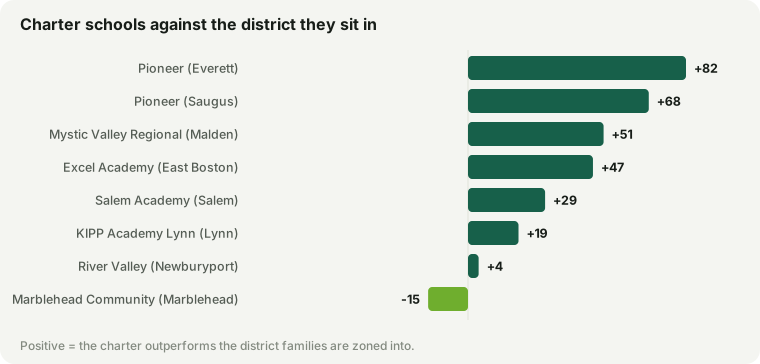
The instinct is that a charter is an upgrade. Sometimes it is an enormous one. But the size of the prize depends almost entirely on the district you are escaping — and in one case here, it runs backwards.
| Charter school | Where | Grades | Charter MCAS | Host district | Difference |
|---|---|---|---|---|---|
| Pioneer Charter School of Science | Everett | K–12 | 89th | 7th | +82 |
| Pioneer Charter School of Science II | Saugus | K–12 | 92nd | 24th | +68 |
| Mystic Valley Regional Charter School | Malden | K–12 | 84th | 33rd | +51 |
| Excel Academy Charter School | East Boston | 5–12 | 69th | 22nd | +47 |
| Salem Academy Charter School | Salem | 6–12 | 50th | 21st | +29 |
| KIPP Academy Lynn Charter School | Lynn | K–12 | 21st | 2nd | +19 |
| River Valley Charter School | Newburyport | K–8 | 73rd | 69th | +4 |
| Marblehead Community Charter Public School | Marblehead | 4–8 | 67th | 82nd | -15 |
A charter seat is worth most exactly where the local district is weakest. Pioneer Charter School of Science in Everett sits 82 percentile points above the district its students would otherwise attend — the difference between the 7th percentile and the 89th. That is a life-changing gap, and it is why charter lotteries in those cities are oversubscribed many times over.
Run the same comparison in a strong district and it inverts. Marblehead Community Charter Public School scores at the 67th percentile — genuinely respectable, and 15 points below the Marblehead district it sits inside. For a Marblehead family, winning that lottery is not an academic upgrade by this measure. It might still be the right school for a particular child, for reasons of size or approach that a percentile cannot see. It is just not a way to buy a better district average, and nobody should enter it believing otherwise.
A correction we owe Salem readers
Building this article surfaced a bug in our own data, and it is worth stating plainly because it changed a number we had published.
Our importer matches each charter to its DESE district record by name. Salem Academy Charter School was matching to the Salem Public Schools record instead of its own, because our matcher strips words like “academy”, “charter” and “school” as noise — which collapses the charter’s name and the city’s name to the same token. The site was therefore showing the charter at the 21st percentile: the district’s number, not its own.
The correct figure, from the school’s own DESE district record, is the 50th percentile — and a 95.6% graduation rate. We understated it by 29 percentile points. It is fixed; we re-ran the match for all 69 charters in our statewide dataset and this was the only one that changed, and the town-level school figures used throughout the site were never affected.
It also sharpens a point from the Salem decision article: the charter option there is a stronger card than we gave it credit for. It is still a lottery, and you still cannot plan around it.
Charter access is a map, not a menu
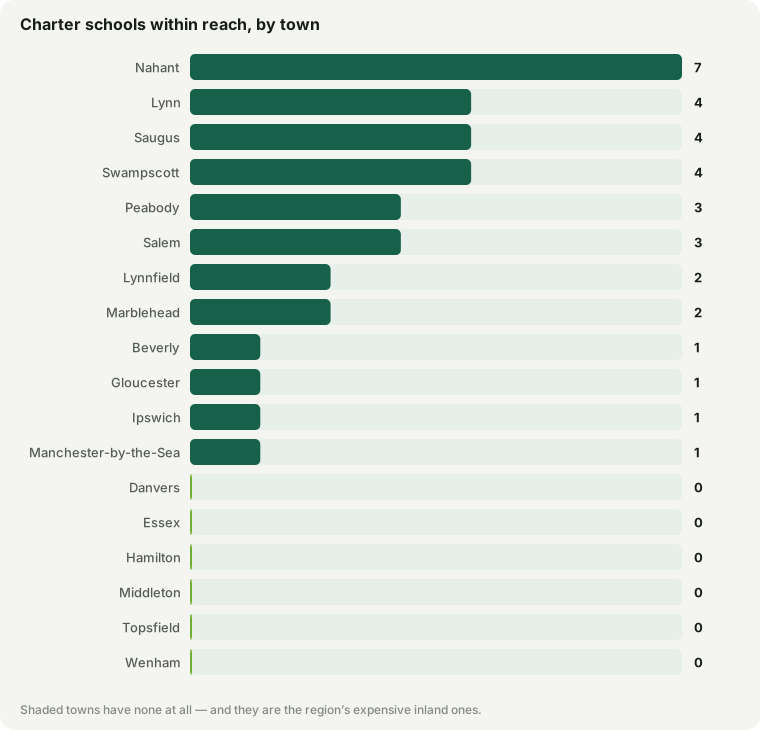
The second thing the data shows is geographic, and it cuts against the usual assumption. Charters cluster at the Boston end of the North Shore, near the cities they were founded to serve.
| Town | Charters within reach | Private schools within reach |
|---|---|---|
| Nahant | 7 | 10 |
| Lynn | 4 | 14 |
| Saugus | 4 | 13 |
| Swampscott | 4 | 13 |
| Peabody | 3 | 14 |
| Salem | 3 | 13 |
| Lynnfield | 2 | 16 |
| Marblehead | 2 | 11 |
| Beverly | 1 | 12 |
| Gloucester | 1 | 12 |
| Ipswich | 1 | 13 |
| Manchester-by-the-Sea | 1 | 12 |
| Danvers | 0 | 14 |
| Essex | 0 | 13 |
| Hamilton | 0 | 13 |
| Middleton | 0 | 17 |
| Topsfield | 0 | 14 |
| Wenham | 0 | 14 |
Nahant has 7 within reach. Danvers, Essex, Hamilton, Middleton, Topsfield, Wenham have none at all. Those are the region’s inland and outer towns, and they are not poor — they are among its most expensive. If you are buying in one of them, the charter option is not on your table, and the district you buy is the district you get. Private schools, by contrast, are available essentially everywhere on this coast.
The private ladder, honestly banded
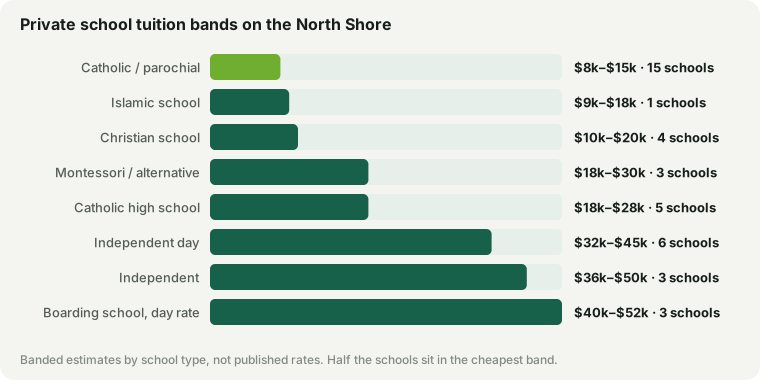
There are 40 non-placement private schools in or near the region. The word “private” covers a range so wide it is nearly useless as a category: the dearest band starts at 5× the cheapest band’s floor.
| Type | Typical annual tuition | Schools |
|---|---|---|
| Catholic / parochial | $8,000–$15,000 | 15 |
| Islamic school | $9,000–$18,000 | 1 |
| Christian school | $10,000–$20,000 | 4 |
| Montessori / alternative | $18,000–$30,000 | 3 |
| Catholic high school | $18,000–$28,000 | 5 |
| Independent day | $32,000–$45,000 | 6 |
| Independent | $36,000–$50,000 | 3 |
| Boarding school, day rate | $40,000–$52,000 | 3 |
The affordable private option on the North Shore is Catholic. Of the 40 schools, 15 — 38% — are parochial elementary schools in the $8,000–$15,000 band. That is a different financial conversation from the $40,000–$52,000 day rate at the boarding schools, and it is the band that most changes the buy-versus-tuition math, because it can be cheaper than the mortgage difference between two towns.
Our district-premium article works through exactly that comparison, and the calculator lets you put your own tuition figure against your own two towns.
How to actually use this
- Never plan around a lottery. A charter seat is allocated by chance, not address, and never guaranteed for a given child in a given year. Treat it as upside on the option you would have chosen anyway, not as the plan.
- Check the gap, not the label. “There is a charter here” means very little on its own. What matters is the distance between the charter and the district you would otherwise use, and in this region that ranges from +82 to -15 points.
- Price the parochial band before the independent one. If tuition is the route, the $8,000–$15,000 band is where staying put most often beats moving. The $40,000–$52,000 band rarely does.
What these numbers are not
- Tuition figures are banded estimates by school type, not published rates. We show ranges because that is the precision our data actually supports. Every school sets its own tuition and most offer aid; check with the school.
- MCAS percentile compares districts, and charters serve different populations. A charter’s intake is not its host district’s intake, so the difference column is a comparison of outcomes, not a controlled measure of teaching. Student growth percentiles, which we show on town pages, are the fairer measure and cluster far more tightly than achievement does.
- “Within reach” means near, not guaranteed. Charter enrolment regions are set by the school and do not always follow distance. Confirm eligibility with the school before it factors into where you buy.
- 7 specialised placement schools are excluded from the counts above. They serve specific documented needs and are not an alternative to a district in the way this article means.
Charter and district performance from MA DESE; tuition bands are estimates by school type; region defined by the MAPC North Shore Task Force. Data last reviewed . Sources in the methodology. Related: the best North Shore towns under $900,000.