The best Massachusetts towns if you don’t commute to Boston
The same school tier costs 26% less outside the Boston commute shed. If you work in Springfield or Worcester, that premium is a discount you collect.
Almost every Massachusetts house-hunting tool, this one included, quietly assumes you are going to Boston. Prices assume it, advice assumes it, and the whole map is drawn as rings around one point. If your job is in Springfield, Worcester, Providence or your spare bedroom, you are being sold a premium you will never use.
A warning about our own data first
I want to be straight about the limits before the numbers, because this is the one article on the site where our main measure does not apply.
Every commute figure in the table below points at Boston. We have since measured real scheduled times to four other job centres from the MBTA timetable — but every one of them is still in Greater Boston, and none of them is Springfield or Worcester. We have no measured drive times to those, and I am not going to invent them: a plausible-looking commute number that nobody measured is worse than no number. So this article does something narrower and honest: it shows what the Boston commute penalty does to prices, and names the towns where that penalty is being charged to people who will never pay it. The distances to other cities below are straight-line miles, which is geometry, not a commute. Check a real route before you act on any of it.
What distance from Boston does to price
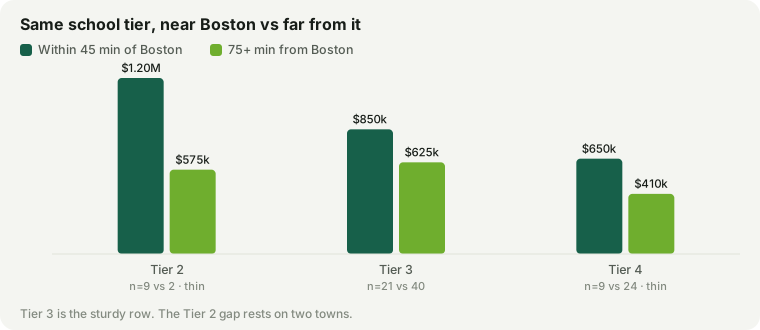
Hold the school tier constant and compare towns within 45 minutes of Boston against towns 75 minutes or more away:
| School tier | Within 45 min | 75+ min | Difference | As % |
|---|---|---|---|---|
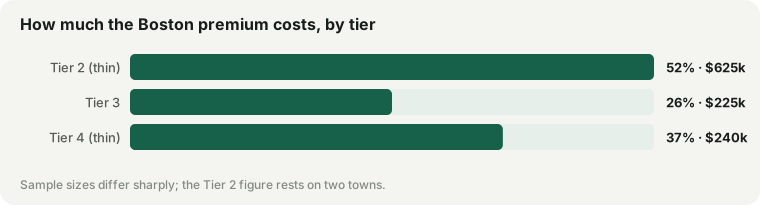
| Tier 2 | $1.2M | $575k | $625k | 52% |
| Tier 3 | $850k | $625k | $225k | 26% |
| Tier 4 | $650k | $420k | $230k | 35% |
The sturdy row is Tier 3, where 21 towns near Boston and 39 far from it give the comparison something to stand on: the same school tier costs 26% less — $225k — once you leave the Boston commute shed.
The Tier 2 row is the dramatic one, at 52%, and it rests on 2 towns. That is not a finding, it is an anecdote with a percentage sign, and I would rather say so than let it headline the article. It is directionally consistent with the row beneath it, and that is all it is.
The towns this actually names
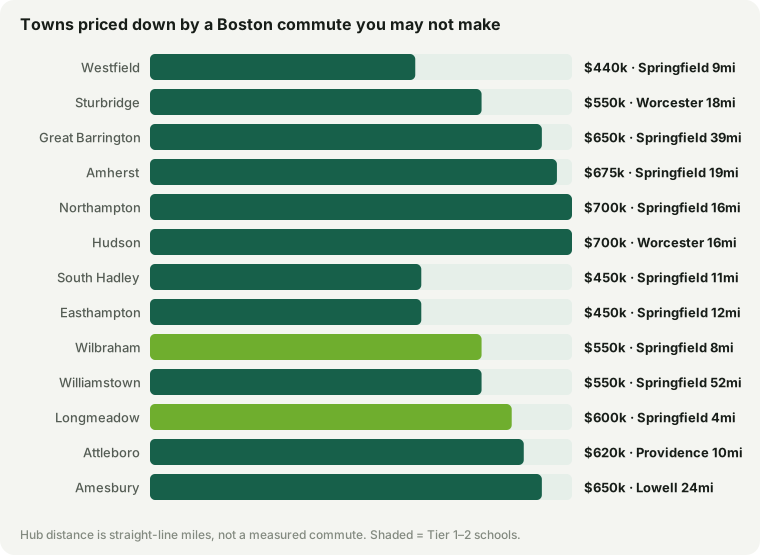
13 towns are priced at or under $750k, sit 60+ modeled minutes from Boston, have a Tier 3 district or better, and are closer to another employment center than to Boston. Reasons are listed rather than scored, so you can see why each is here.
| Town | 4BR | Schools | Est. tax bill | To Boston | Nearest hub (straight line) | Why it is here |
|---|---|---|---|---|---|---|
| Westfield | $440k | Tier 3 | ≈$6,600 | 126 min | Springfield, 9 mi | high culture score, compact town center |
| Sturbridge | $550k | Tier 3 | ≈$8,600 | 94 min | Worcester, 18 mi | high culture score, compact town center |
| Great Barrington | $650k | Tier 3 | ≈$8,600 | 155 min | Springfield, 39 mi | high culture score, compact town center |
| Amherst | $675k | Tier 3 | ≈$11,400 | 112 min | Springfield, 19 mi | high culture score, compact town center |
| Northampton | $700k | Tier 3 | ≈$9,600 | 121 min | Springfield, 16 mi | high culture score, compact town center |
| Hudson | $700k | Tier 3 | ≈$9,900 | 60 min | Worcester, 16 mi | high culture score, compact town center |
| South Hadley | $450k | Tier 3 | ≈$6,100 | 116 min | Springfield, 11 mi | high culture score |
| Easthampton | $450k | Tier 3 | ≈$6,000 | 121 min | Springfield, 12 mi | compact town center |
| Wilbraham | $550k | Tier 2 | ≈$9,600 | 110 min | Springfield, 8 mi | strong district |
| Williamstown | $550k | Tier 3 | ≈$7,800 | 151 min | Springfield, 52 mi | high culture score |
| Longmeadow | $600k | Tier 2 | ≈$11,600 | 118 min | Springfield, 4 mi | strong district |
| Attleboro | $620k | Tier 3 | ≈$7,600 | 66 min | Providence, 10 mi | compact town center |
| Amesbury | $650k | Tier 3 | ≈$9,800 | 73 min | Lowell, 24 mi | compact town center |
The clearest single example
Longmeadow is a Tier 2 school district at $600k. The median Tier 2 town within 45 minutes of Boston is $1.2M.Longmeadow sits about 4 straight-line miles from downtown Springfield.
If you work in Springfield, the 118-minute Boston commute in our data is not a cost you pay. It is a discount you collect, and it is roughly $600k on the purchase price for a district in the same tier. There is no trick in it and nothing hidden — the town is simply priced by a market that is bidding on access to a city you are not driving to.
The same logic, less extremely, covers the Pioneer Valley college towns. Northampton and Amherst both score 10/10 on culture in our model, the joint highest in Massachusetts, at $700k and $675k. In the eastern half of the state, that cultural density does not exist at any price, let alone that one — which we found separately when we compared the college towns.
Who this is and is not for
- Genuinely for: people employed in or near Springfield, Worcester, Providence, Lowell or New Bedford; fully remote workers; retirees; and anyone whose partner’s job anchors them west of 495 already.
- Not for: hybrid workers who assume two days is fine. Two days a week from Longmeadow, at 118 minutes each way, is 8 hours of driving a week, and hybrid schedules have a way of becoming three days. Price the commute you might have, not the one you were promised.
- Not a bet on appreciation. These towns are cheaper partly because demand is thinner. The same distance from Boston that gets you the discount is also why the discount persists, and it may still be there when you sell.
What we are not claiming
- We have not measured a single non-Boston commute. The hub column is straight-line distance. Real drive times depend on routes, traffic and where in the town you live, and can be far longer than the mileage suggests.
- Straight-line distance to a city center is not proximity to a job. Employment is spread across metro areas, not concentrated at the coordinates we measured from.
- Medians over small groups are fragile. Sample sizes are in the table. Two of the three rows are thin and are labeled.
- Cheaper towns can carry heavier tax bills. The bill column is in the table because the rate varies independently of price — the rate-versus-bill problem is at its worst in exactly these towns.
Prices are modeled medians calibrated to Zillow ZHVI and Redfin; school tiers are editorial, built on MA DESE data; tax bills are estimates; Boston commutes are door-to-door, rail legs from the MBTA timetable and driving modeled; distances to other cities are straight-line. Data last reviewed . Sources in the methodology. Related: what a strong district actually costs and what $750,000 buys.