One school ranking dropped eight of its top 25 towns in a year. The other dropped two.
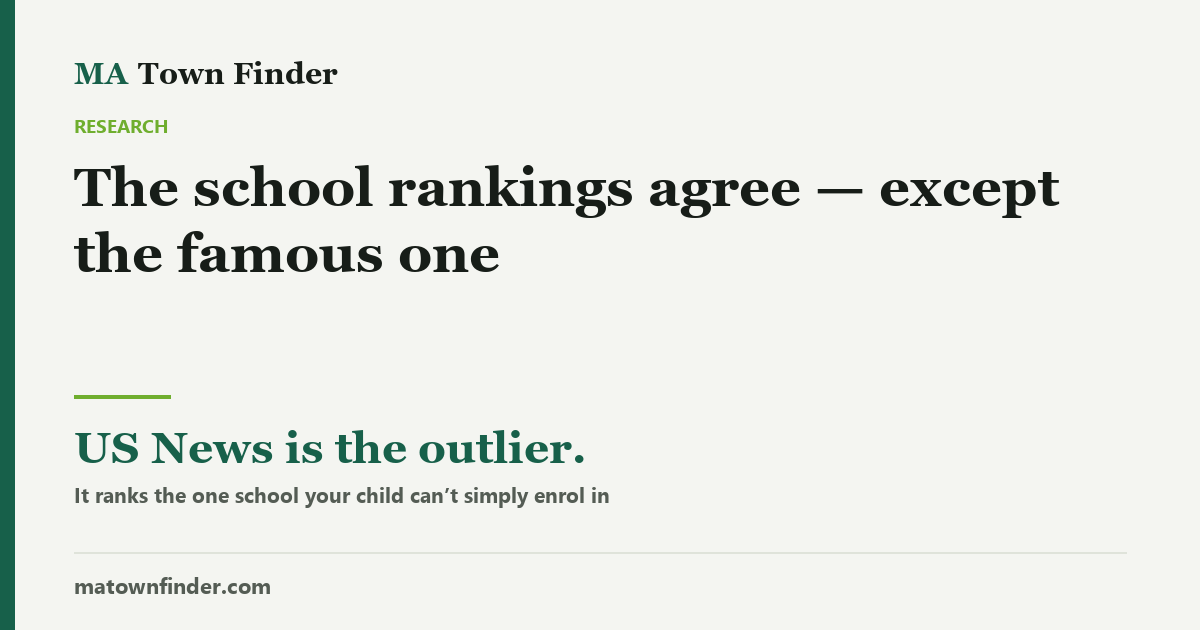
Shortlist towns from a school ranking and a year later the list has moved underneath you. Setting the 2026 editions of U.S. News and Boston Magazine against the ones this site published before them: the typical town moved 10 places on the U.S. News list and 5 on Boston Magazine’s, Falmouth fell 71, and of the 25 best-ranked towns on each list a year ago, U.S. News kept 17 and Boston Magazine 23. The steadier list is the one that most closely reproduces the state’s own test scores — r = −0.86, against −0.25.
A family shortlisting towns reads a ranking, writes down five or six names, and then spends a year looking at houses. This site has already asked whether the different publishers agree with each other about a town on any given day. The question underneath that one is narrower and more practical: does a publisher agree with itself a year later?
It is answerable now because the site loaded the 2026-27 U.S. News rankings and the 2026 Boston Magazine list in September, and the editions they replaced are still in the repository’s own history. Both rank on newer test data than the site’s state figures, so some of what follows is real news about a school. The point is how much of it there is — and the two publishers are not remotely alike.
Of last year’s top 25 towns, one list dropped eight
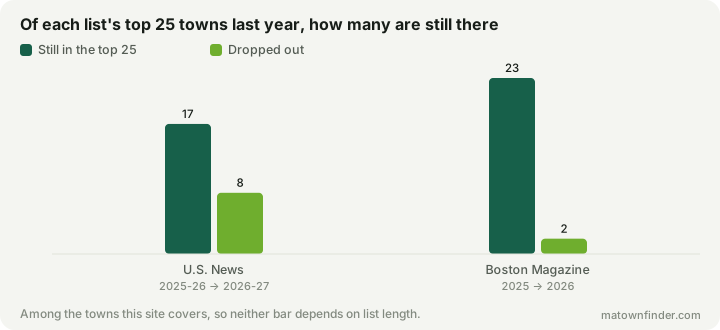
Rank this site’s towns by where each publisher put them, take the top 25, and come back a year later. Boston Magazine still has 23 of its 25. U.S. News has 17 — it dropped eight towns out of its own top 25 in twelve months, among them Southborough, Northborough, Winchester, Westborough and Wellesley. Boston Magazine dropped two: Norwell and Medfield.
Nothing about those towns collapsed. Southborough went from 12th among the towns here to 31st; Northborough, from 13th to 32nd. They are still good districts. They are simply no longer on the shortlist a reader would have written down.
The typical town moved ten places, or five
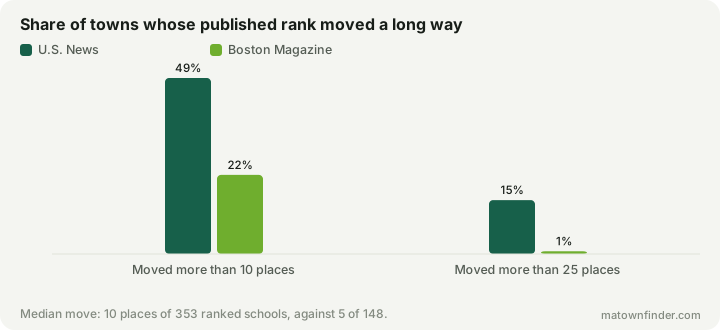
Across the 101 towns U.S. News ranks here, the median town moved 10 places and 15 moved more than 25. Across the 133 Boston Magazine ranks, the median moved 5 and 1 moved more than 25. The largest single move on either list is Falmouth, which fell from 76th to 147th in the U.S. News table — a drop of 71 places in one year.
One thing that cuts the other way
Those two medians are not quite comparable, and the reason is worth putting plainly rather than burying. U.S. News ranks 353 Massachusetts high schools; Boston Magazine ranks 148 in its Greater Boston list. Ten places out of 353 and five out of 148 are almost the same distance. Measured as a move in percentile of each publisher’s own field, the two are close: 2.9 points against 3.4, with the largest move on each list about 21 points.
So U.S. News is not simply the noisier operation. What is true — and it is the thing that reaches a reader — is that within the set of towns a Massachusetts family actually chooses between, its list reshuffles far more. That is what the top-25 counts above measure, and they do not depend on either denominator.
The check that had to be run
U.S. News covers 101 of the towns here and Boston Magazine 133, so every contrast above could in principle be a difference between two sets of towns rather than between two rankings. On the 87 towns both publishers rank, the finding holds and sharpens: the median town moves 9 places on the U.S. News list against 4 on Boston Magazine’s, and the top 25 keeps 18 against 23.
Two other things were checked before any of this was written. No town’s matched high school changed between editions, so no “move” here is really the site pointing at a different school. And nobody entered or left either ranking, so no move is an entry or an exit.
What the steadier list is steady about
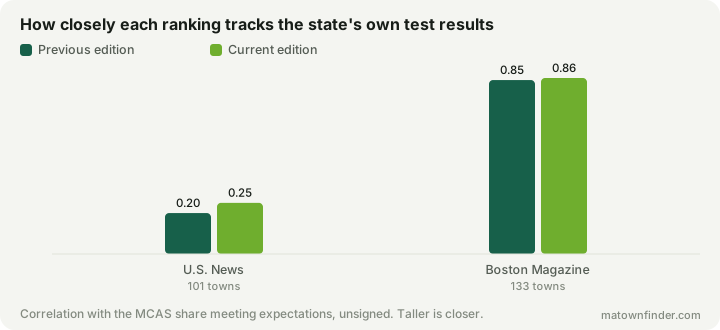
Boston Magazine’s order sits close to the state’s own test results — r = −0.86 against the share of students meeting expectations on MCAS, essentially unchanged from −0.85 a year ago. U.S. News’s tracks them at −0.25. On the towns both rank, the gap is −0.79 against −0.19.
That is most of the explanation. A list that closely follows test scores will move about as much as test scores do, which is not much from one year to the next. A list built on more ingredients — U.S. News weighs college readiness, graduation and performance among underserved students — has more that can move, and it moves. Neither is cheating. They are measuring different things, and the two agree with each other only at r = 0.38, which is less than either agrees with its own previous edition.
What this does not show
It does not show that the schools stood still. The publishers rank on test data newer than the state release this site carries, and some of this movement is a real change at a real school. Nothing here can separate the two, and a town that fell fifty places deserves a look rather than a shrug.
It also does not make the steadier list the better one. Stability is not accuracy. A ranking that reproduces MCAS is stable because MCAS is stable, and this site has argued at length that test scores mostly measure the families in the building. You can be consistent and consistently measuring the wrong thing.
How to use this
- Note the edition, not just the rank. “Top 20 in Massachusetts” means very little without the year attached. On the U.S. News list, eight of last year’s top 25 towns here are no longer in it.
- Treat a move of ten places as noise. That is the median U.S. News town. Movement on that scale is what the list does every year, not a signal about a district.
- Go to the underlying numbers. The state’s own accountability verdict and the MCAS shares behind it change slowly and are published in full. Every town page here shows them.
- If two lists disagree about your town, that is normal. They agree with each other at 0.38. Read what each one is actually counting before deciding which to believe.
How this was measured
The current figures are the U.S. News Best High Schools 2026-27 rankings and the Boston Magazine 2026 Best Public Schools list, as loaded in September 2026. The previous figures are the 2025-26 and 2025 editions this site published until then, recovered from its own git history rather than re-scraped, so they are exactly what was shown here. A town’s rank is its matched high school’s; 101 towns carry a U.S. News rank and 133 a Boston Magazine one, and Boston’s neighborhoods share the city’s entry and count once. Moves are reported three ways — in published places, in percentile of each publisher’s ranked field (366 then 353 schools for U.S. News, 150 then 148 for Boston Magazine), and in position among the towns this site covers — because the first depends on a denominator that changed. MCAS agreement is the correlation between rank and the share of students meeting or exceeding expectations. See the methodology, or download the tables. Figures as of September 17, 2026.