Massachusetts towns with a real downtown under $1M
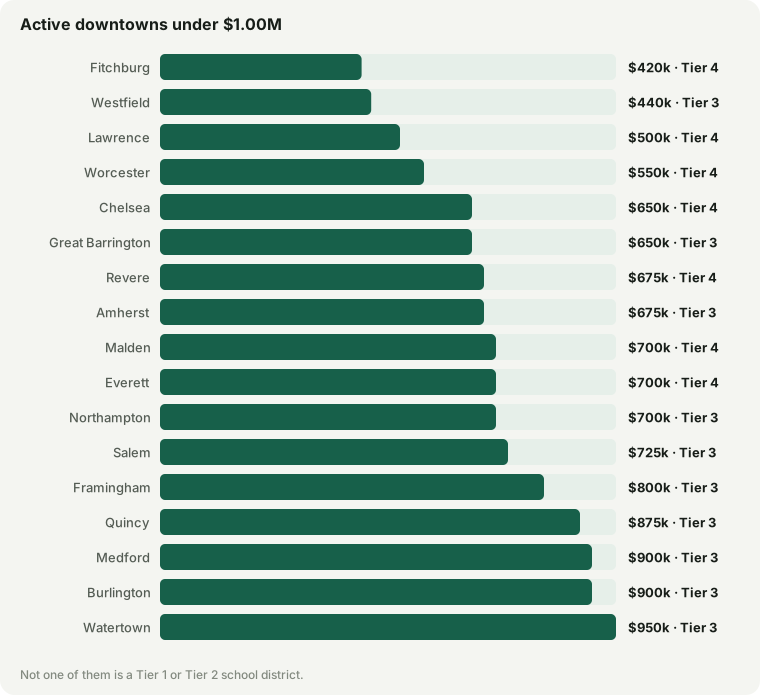
Seventeen towns have a genuinely active center and a median 4BR under $1M. Not one of them has a Tier 1 or Tier 2 school district.
Plenty of Massachusetts towns are pretty. Far fewer have somewhere to go on a Tuesday night. We score that separately from walkability, because a town can have a perfectly strollable center with nothing open in it — and the two dimensions come apart more often than you would think.
How this is measured
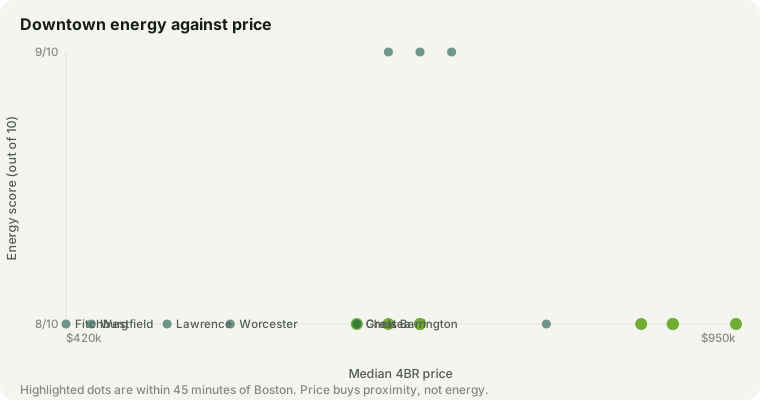
“Active” here is the energy dimension of our town model at 8 or above: commercial density and evening activity, the thing that makes a downtown feel switched on rather than well-preserved. 24 of 223 municipalities clear that bar. 17 of them have a median 4BR under $1M, and the cheapest is Fitchburg at $420k.
All 17 of them
| Town | 4BR | Energy | Walkable | Culture | Schools | Commute | Est. tax bill |
|---|---|---|---|---|---|---|---|
| Fitchburg | $420k | 8/10 | 7/10 | 8/10 | Tier 4 | 80 min | ≈$5,600 |
| Westfield | $440k | 8/10 | 7/10 | 8/10 | Tier 3 | 126 min | ≈$6,600 |
| Lawrence | $500k | 8/10 | 9/10 | 8/10 | Tier 4 | 58 min | ≈$4,300 |
| Worcester | $550k | 8/10 | 8/10 | 8/10 | Tier 4 | 77 min | ≈$7,300 |
| Chelsea | $650k | 8/10 | 10/10 | 8/10 | Tier 4 | 24 min | ≈$7,500 |
| Great Barrington | $650k | 8/10 | 7/10 | 10/10 | Tier 3 | 155 min | ≈$8,600 |
| Revere | $675k | 8/10 | 9/10 | 7/10 | Tier 4 | 25 min | ≈$6,000 |
| Amherst | $675k | 9/10 | 8/10 | 10/10 | Tier 3 | 112 min | ≈$11,400 |
| Malden | $700k | 8/10 | 9/10 | 8/10 | Tier 4 | 19 min | ≈$8,000 |
| Everett | $700k | 8/10 | 9/10 | 7/10 | Tier 4 | 24 min | ≈$8,800 |
| Northampton | $700k | 9/10 | 8/10 | 10/10 | Tier 3 | 121 min | ≈$9,600 |
| Salem | $725k | 9/10 | 9/10 | 10/10 | Tier 3 | 47 min | ≈$7,800 |
| Framingham | $800k | 8/10 | 8/10 | 8/10 | Tier 3 | 52 min | ≈$9,500 |
| Quincy | $875k | 8/10 | 9/10 | 8/10 | Tier 3 | 22 min | ≈$10,300 |
| Medford | $900k | 8/10 | 8/10 | 8/10 | Tier 3 | 16 min | ≈$7,800 |
| Burlington | $900k | 8/10 | 7/10 | 6/10 | Tier 3 | 41 min | ≈$7,800 |
| Watertown | $950k | 8/10 | 9/10 | 8/10 | Tier 3 | 31 min | ≈$11,600 |
The pattern in the schools column
Read down it. Not one of these 17 towns has a Tier 1 or Tier 2 school district. Every single town in Massachusetts with a genuinely active downtown and a median 4BR under $1M is Tier 3 or Tier 4.
This is the same wall we hit from two other directions — on the North Shore under $900k, and statewide at $750k. It is not a coincidence and it is not a quirk of our tiering. Places with dense, busy, mixed-use downtowns in this state are overwhelmingly cities, and Massachusetts cities have the districts they have. If you want a lively center and a top-tier district in the same municipality, you are shopping in a very short, very expensive list — 7 towns clear the energy bar above $1M, and that is where those two things meet.
The ones you can actually commute from
8 of the 17 are within 45 modeled minutes of downtown Boston:
- Chelsea — $650k, 24 min · energy 8/10, walkable 10/10, culture 8/10, commuter rail
- Revere — $675k, 25 min · energy 8/10, walkable 9/10, culture 7/10, on the subway
- Malden — $700k, 19 min · energy 8/10, walkable 9/10, culture 8/10, on the subway
- Everett — $700k, 24 min · energy 8/10, walkable 9/10, culture 7/10
- Quincy — $875k, 22 min · energy 8/10, walkable 9/10, culture 8/10, on the subway
- Medford — $900k, 16 min · energy 8/10, walkable 8/10, culture 8/10, on the subway
- Burlington — $900k, 41 min · energy 8/10, walkable 7/10, culture 6/10
- Watertown — $950k, 31 min · energy 8/10, walkable 9/10, culture 8/10
That list is mostly the inner ring north of Boston, and it is the cheapest way in this state to live somewhere busy without a long drive. The trade is the district, every time.
The cultural outliers are all far away
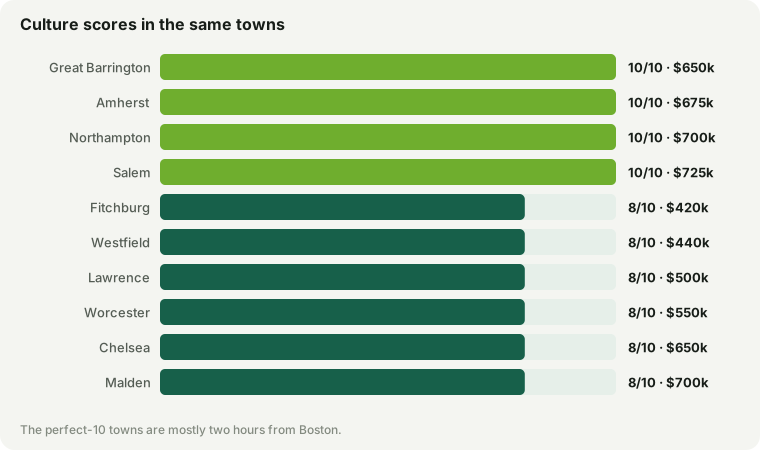
4 towns on this list score a perfect 10 for culture: Great Barrington ($650k, 155 min), Amherst ($675k, 112 min), Northampton ($700k, 121 min), Salem ($725k, 47 min).
3 of those are two hours from Boston, and one is 47 minutes away — which is the fact that made me build the vibe model in the first place, because I live in it. What the distance buys, in the western towns, is a genuinely unusual concentration of theatres, galleries and college culture at prices the eastern half of the state cannot approach. What it costs is any relationship with the Boston job market, and whether that is a real cost depends entirely on where you work.
What the score does not know
- Energy is a description, not a compliment. A high score means commercial and evening activity — that includes traffic, parking and noise. Several towns here score high partly because they are dense cities. Whether that is the point or the problem is yours to decide.
- A town-wide score is not a neighbourhood. Large municipalities average a busy center with quiet residential edges. Our score describes the town; your street may be nothing like it.
- Scores come from our six-dimension model, built from mapped amenity counts and a rubric, not from visiting. The methodology explains what feeds each dimension.
- Prices are modeled medians; commutes point at downtown Boston, with rail legs from the MBTA timetable and driving still modeled from distance.
Vibe scores from our six-dimension town model; prices and tax bills are estimates; school tiers are editorial, built on MA DESE data; commutes are modeled. Data last reviewed . Sources in the methodology. Related: the most compact town centers and the quiet end of the same scale.