Three bedrooms to five-plus costs $22,000 in Ware and $1.6M in Barnstable
Zillow publishes its price index split by bedroom count, so the cost of space in a town can now be read off a source instead of modeled. Statewide the step from a 3BR to the 5+ BR bucket is 1.44x — but it is 1.06x in Ware and 3.23x in Barnstable, and what sorts them is the price of the town (r = 0.60), not the commute (r = −0.03). Across the towns this site covers, the market for small homes runs 5.7-fold; the market for big ones runs 12.3-fold. In 39 towns the whole top of the local market costs less than a typical three-bedroom statewide.
Every price on this site, and on most sites, answers one question: what does this town cost. A family that already knows the answer and is now asking a second question — what does more space cost here — has had nothing to read, because a single median per town cannot say.
Zillow publishes its index split by bedroom count. That gives two observed points per town rather than one: the median 3BR home, and the median home in the top bucket. The distance between them is the price of moving up the market where you live, and it is not a constant. It is barely even a range.
The same move, 1.06x in one town and 3.23x in another
Across the 207 towns Zillow prices at both ends, the median step is 1.44x — about $278k to go from a three-bedroom home to the top of the local market. That is the number a reader would guess, and it is the least interesting thing here.
In Ware the step is 1.06x: $369k for the three-bedroom, $391k for the 5+ BR. The extra space costs $22,000. In Barnstable the same step is 3.23x — $717k to $2.32M, a difference of $1.6M. 29 towns price the move under 1.25x; 17 more than double.
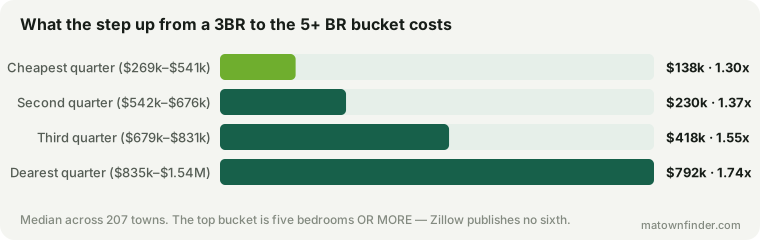
Sorted by what the town costs, the pattern is clean and steep. In the cheapest quarter the move up costs $137,500. In the dearest it costs $792,000 — 5.8 times as much for the same step, in a town that was already several times dearer to enter.
It tracks the town, and not the map
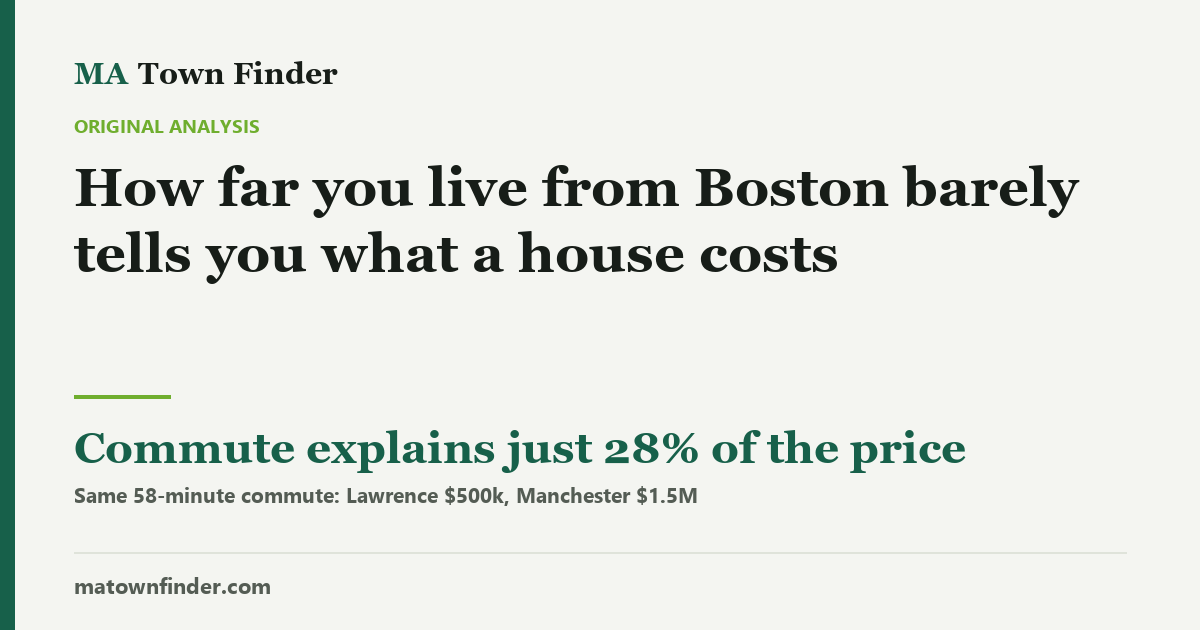
The obvious explanation would be land: space is dear where land is dear, and land is dear near Boston. That is not what the data says. The step correlates with the price of the town at r = 0.60 and with the commute to Boston at r = −0.03, which is nothing at all.
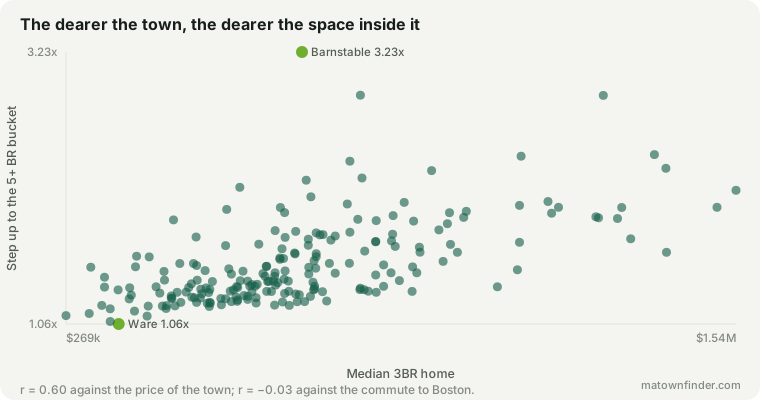
Which is consistent with the rest of the price writing here: the map explains far less than people assume. The steepest steps here come from two unrelated kinds of place. Barnstable, Mashpee, Chatham are the Cape, an hour and a half out, where nobody is commuting and the top of the market is waterfront. Brookline (24 min) and Cambridge (14 min) are the opposite case: dense inner cities where a large single-family house is scarce at any price. The flattest steps — Ware, Athol, Winchendon — are far out and cheap, and the two facts are doing separate work.
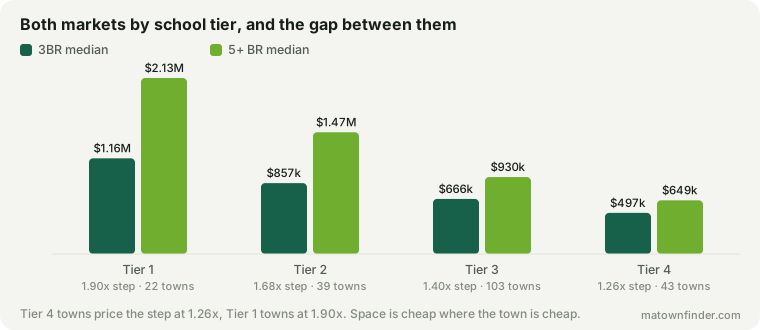
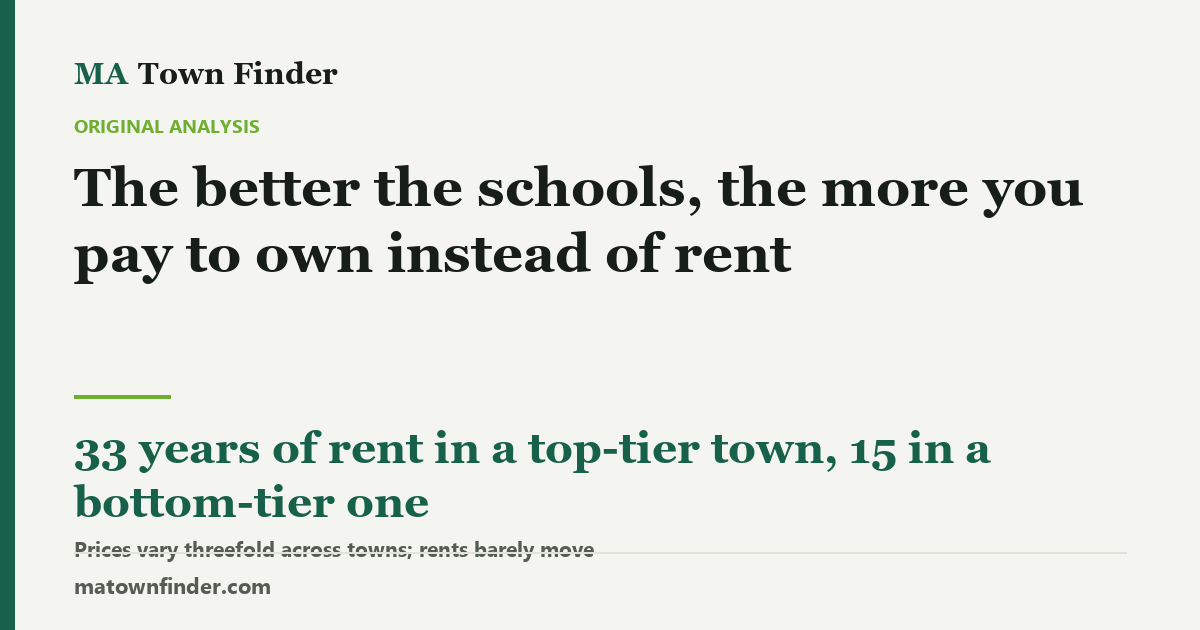
By school tier the same thing shows up as two ladders climbing at different rates. A Tier 4 town has a median 3BR of $497k and a median 5+ BR of $649k — a step of 1.26x. A Tier 1 town runs $1.16M to $2.13M, a step of 1.90x. Buying into a top district costs 2.3x more at three bedrooms and 3.3x more at the top of the market. The school premium is bigger for families who need the space, which is most families who care about schools.
Two markets, and one is far less equal than the other
Put the two series side by side across every town here and the consequence is stark. The three-bedroom market runs from $269k to $1.54M — a 5.73-fold spread. The top bucket runs from $303k to $3.72M, a 12.27-fold spread.
Where you live decides roughly twice as much about what you pay if what you need is space. A family that can live in three bedrooms is choosing between towns inside a factor of six. A family that cannot is choosing inside a factor of twelve, and the towns at the top of that range are not the towns at the top of the other one.
39 towns where the top of the market is a bargain
The most usable version of this: in 39 towns the typical 5+ BR home costs less than the typical three-bedroom home statewide ($673k).
| Town | 3BR | 5+ BR | Step | Commute |
|---|---|---|---|---|
| North Adams | $269k | $303k | 1.13x | 145 min |
| Springfield | $313k | $358k | 1.14x | 116 min |
| Athol | $353k | $381k | 1.08x | 100 min |
| Ware | $369k | $391k | 1.06x | 101 min |
| Chicopee | $337k | $407k | 1.21x | 116 min |
| Palmer | $353k | $417k | 1.18x | 103 min |
| Greenfield | $342k | $463k | 1.35x | 119 min |
| Gardner | $399k | $464k | 1.16x | 88 min |
| Winchendon | $423k | $475k | 1.12x | 93 min |
| Pittsfield | $316k | $478k | 1.51x | 151 min |
The catch is the commute column, and it is a real catch — these are the western and north-central towns, 88 minutes from Boston at the very nearest. But the trade is not the one people assume they are making. They think they are trading distance for a cheaper house. They are also, separately, trading it for a market where the extra bedrooms are nearly free.
What the top bucket actually is
One thing has to be said plainly, because it is the difference between this being useful and being misleading. Zillow’s bedroom buckets run one to five and stop. There is no sixth. So the top bucket is five bedrooms or more, and it carries every eight-bedroom house in the town along with the five-bedroom ones.
That is most of why Barnstable reads 3.23x. Read the step as “what moving up this town’s market costs”, not as the price of exactly two bedrooms. Every label on this site says 5+ BR rather than a flat five, for that reason.
How to use this
- Price the house you will need, not the one you are buying. A family planning a third child in a Tier 1 town is looking at a 1.90x step ahead of them, not the 1.26x one the statewide average implies.
- The cheap towns are cheaper than they look, for big families. The headline price gap between a cheap town and a dear one understates the gap at four and five bedrooms, by a lot.
- Do not use this to compare against the site’s own prices. These are observed Zillow medians for the middle third of the market. The 4BR figures elsewhere here are modeled estimates for one archetype. They answer different questions and will not match.
How this was measured
Both figures are the Zillow Home Value Index by bedroom count, smoothed and seasonally adjusted, at the city level, for July 2026. Zillow publishes the bedroom split only for single-family and condos combined — there is no house-only series — so a “3BR” here is a three-bedroom home of either kind.
Coverage is partial and left that way rather than filled in. 207 of the municipalities here carry both figures; Boston’s 18 neighborhoods are not cities and have no series at all, and the smaller towns drop out of the top bucket where Zillow has too few sales to publish one. Quartiles are cut on the town’s own 3BR median so the split and the step come from the same source. School tiers are editorial — see the methodology, or download the tables. Figures as of September 11, 2026.