A paid-off condo and private school, or a mortgage in a better district?
A worked comparison with two children aged four and newborn: a mortgage-free Salem condo with $624,000 of private-school fees ahead of it, against a $1.25M house in Marblehead with a $550k mortgage and free public schools. At inflation the two are finely balanced. At the rates both towns actually delivered over the last decade, it is not close — and that gap is the whole decision.
This is one of the most common dilemmas on the North Shore, and the two sides are unusually hard to compare. On one side, a home you own outright and a tuition bill. On the other, a mortgage and a school system you pay for through the house instead. One of those bills ends. The other one buys an asset. Neither fact shows up in a monthly payment.
So here is the comparison run properly, with one family’s numbers as the worked example.
| Option | Housing | Schools |
|---|---|---|
| Stay | Paid-off Salem condo. $500/mo HOA, $400/mo tax. No mortgage. | Private school for both children — $4,000/mo after aid once both are enrolled. |
| Move | $1,250,000 house in Marblehead, $550,000 mortgage. | Public. Marblehead sits at the 82nd MCAS percentile against Salem’s 21st. |
These numbers are one family’s. To put your own prices, fees and children’s ages through the same model, use the stay-or-move calculator — it runs the arithmetic below on whatever you give it.
The monthly numbers are almost a tie
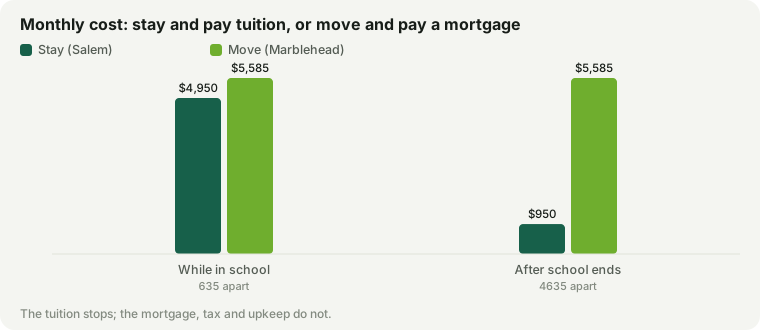
The first surprise is how close they are, once both children are in school. Staying costs $950 a month to keep the condo, plus $4,000 of tuition — $4,950 in all. Moving costs $5,585 a month and no tuition at all.
That is the steady state rather than today. With a four-year-old and a newborn, only one child is enrolled at first, so staying starts at $2,950 a month and does not reach $4,950 until the younger one starts school in year 5. Moving costs the full $5,585 from day one.
| Monthly, year one | Stay | Move |
|---|---|---|
| Mortgage principal & interest | — | $3,476 |
| Property tax | $400 | $892 |
| HOA | $500 | — |
| Insurance | $50 | $175 |
| Maintenance | — | $1,042 |
| Tuition, both children enrolled | $4,000 | — |
| Total | $4,950 | $5,585 |
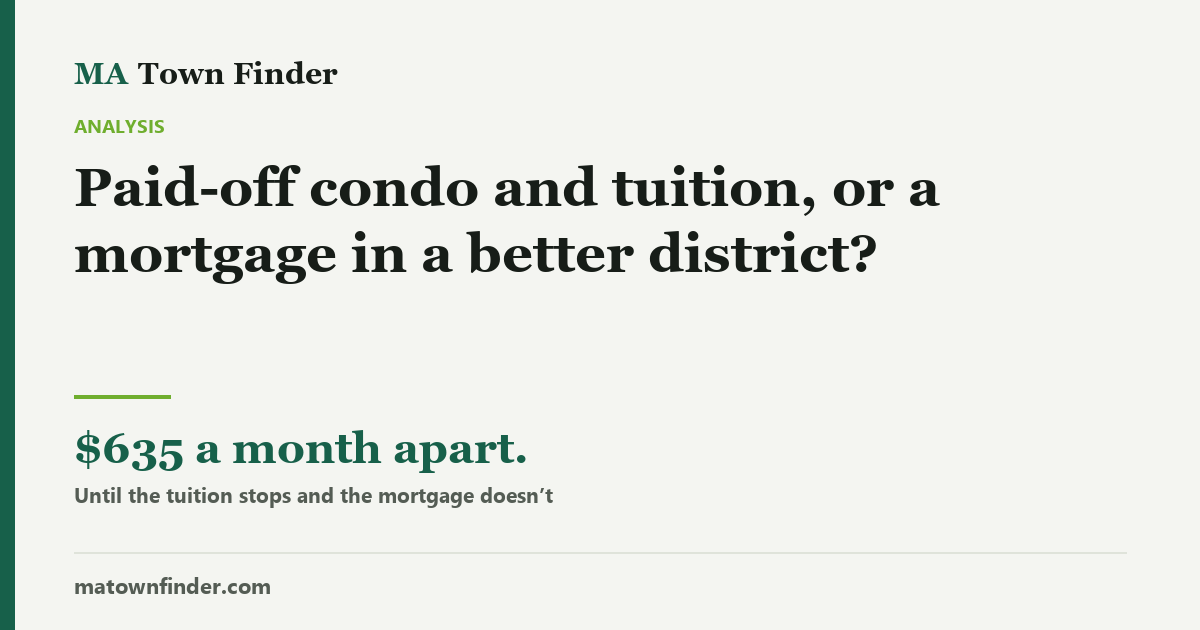
Moving costs $635 a month more — and it is better than that, because $512 of the mortgage payment in year one is principal. That is not money spent; it is money moved from one pocket to another. On a true-cost basis the two options are within about $122 a month of each other. For a decision this size, that is a tie.
The catch: one of these bills ends
The tie only holds while the children are in school. Tuition stops. The mortgage, the higher tax bill and the maintenance on a $1,250,000 house do not.
The day the younger child finishes, staying drops to $950 a month. Moving is still $5,585 — a gap of $4,635 a month, every month, for as long as the mortgage runs. That is the single most important number in this comparison, and it is the one a monthly budget never shows you.
With a four-year-old and a newborn, the bill is long
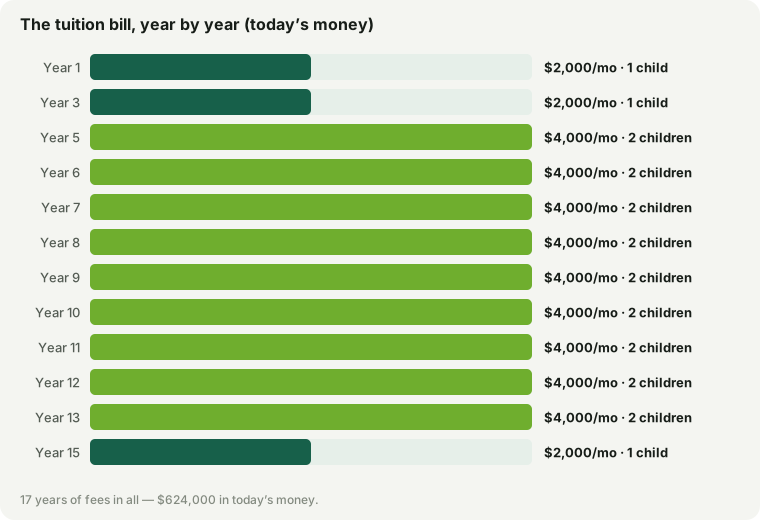
How long the tuition runs is not a guess — the children’s ages settle it. A child of 4 starts kindergarten next year and finishes thirteen years later. A newborn starts in 5 years and finishes in 17. So the fees run for 17 years, and only overlap in the middle.
| Years | Children enrolled | Monthly, today’s money |
|---|---|---|
| 1 to 4 | 1 | $2,000 |
| 5 to 13 | 2 | $4,000 |
| 14 to 17 | 1 | $2,000 |
That is $624,000 of fees in today’s money — the equivalent of 13 years at the full two-child rate, spread across 17. It is also a bill that gets worse before it gets better: the peak years, when both children are enrolled and fees have inflated for a decade, land in the middle of the mortgage you did not take.
Where does the down payment come from?
Before the race, one thing has to be checked, because it is the assumption most likely to be wrong. A $1,250,000 house with a $550,000 mortgage needs $725,000 in cash — the deposit plus closing costs.
The condo has to supply it, and the stated tax bill says how much condo there is. At Salem’s rate of $10.78 per $1,000, a $400 monthly tax bill implies a property assessed around $445,269. Selling that nets roughly $423,006 after costs — which leaves a gap of $301,994 to be found somewhere else.
The move as described needs about $302k of savings on top of the condo. If that money is not there, the mortgage is not $550k — it is $852k, and the monthly cost of moving rises from $5,585 to $7,494. That version of the move is a different question, and a much harder one.
Everything below assumes the savings exist, and that a family staying put keeps them invested rather than spending them — otherwise the two sides are not being compared fairly.
The race, run
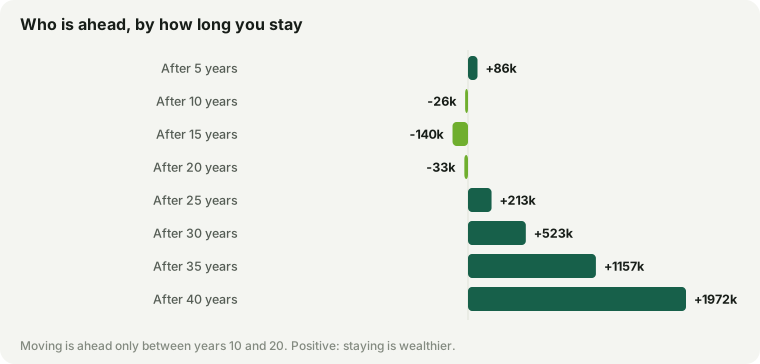
Here is wealth after a given number of years — the condo or the house, grown at the appreciation rate, plus savings, minus what is still owed. Both sides start with the same assets, and whichever option costs less in a given year invests the difference.
| After | Stay | Move | Ahead |
|---|---|---|---|
| 10 years | $1.21M | $1.24M | Move +$26k |
| 15 years | $1.48M | $1.62M | Move +$140k |
| 20 years | $2.01M | $2.04M | Move +$33k |
| 25 years | $2.76M | $2.55M | Stay +$213k |
| 30 years | $3.69M | $3.17M | Stay +$523k |
The answer is not one-directional, and that is the finding. There is no single break-even — there are two. Moving is ahead only between roughly year 10 and year 20. Staying wins on either side of that window.
- Under 10 years: staying wins, because the cost of buying and selling a $1,250,000 house never gets recovered that quickly.
- Years 10 to 20: moving wins. This is the stretch where both children would be in fee-paying school and the bigger house is compounding. The advantage peaks around year 17, at $153k.
- Beyond year 20: staying wins, and the gap widens fast — $213k by year 25 and $523k by year 30. The fees have stopped, the condo is still paid off, and $4,635 a month is compounding instead of servicing a mortgage.
Notice how modest the moving case is even at its best. The most it is ever ahead is $153k; staying is ahead by four times that much if you are still there in thirty years. The move wins a sprint; staying wins the marathon.
What you actually have the day school ends
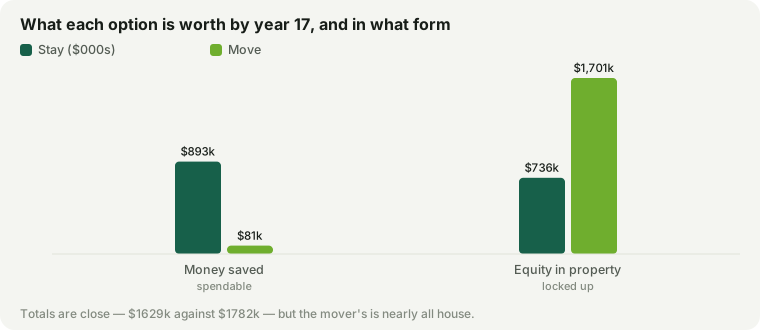
Year 17 is the day the younger child finishes — the point both paths have been aiming at for two decades. The totals land close together. What the money is could hardly be more different.
| By year 17 | Stay | Move |
|---|---|---|
| Property, at market | $735,962 | $2,066,060 |
| Still owed on it | — | −$365,476 |
| Equity in the property | $735,962 | $1,700,583 |
| Money saved | $892,729 | $80,924 |
| Total | $1,628,691 | $1,781,507 |
| Of that total, in cash | 55% | 5% |
Moving is ahead on paper by $152,816. But look at the last row. The family that stayed has $892,729 in savings — 55% of everything they own, in money they can spend. The family that moved has $80,924, or 5%. Their wealth is a house.
That matters more than the headline gap, because of what happens next. The day the second child leaves school is the day college fees begin. One family meets them from $892,729 of savings. The other meets them from $80,924 and a home-equity line.
Where the mover’s equity came from
| Equity built by year 17 | Amount |
|---|---|
| Deposit put in at the start | $700,000 |
| Mortgage principal paid down | $184,524 |
| Rise in the house price | $816,060 |
| Total equity | $1,700,583 |
Two of those three lines are less than they look. The $816,060 rise in the house price is not a profit — houses here are assumed to grow at 3%, the same rate as inflation, so in real terms that house is worth exactly what it was. It kept pace; it did not get ahead. And after 17 years of payments, only $184,524 of the $550k borrowed has actually been repaid. Early mortgage payments are mostly interest.
What each option burned
The cleanest way to see the trade is to count the money that bought nothing you keep.
| Money spent, not saved | By year 17 |
|---|---|
| Staying: tuition cheques written | $865,869 |
| Moving: mortgage interest paid | $524,657 |
$865,869 of tuition against $524,657 of interest. The tuition is the larger number — by $341,213 — and it is the more visible one, which is why it dominates the conversation. But the interest is real money too, and it keeps running for another thirteen years after the tuition stops.
Younger children push it towards moving
These particular ages are what put the family in the moving window at all. Run the same comparison with the children older, and it moves decisively the other way.
| If the children were | Hold 15 yrs | Hold 20 yrs | Hold 25 yrs |
|---|---|---|---|
| 4 and 0 (actual) | Move +$140k | Move +$33k | Stay +$213k |
| 7 and 3 | Move +$98k | Stay +$119k | Stay +$397k |
| 10 and 6 | Stay +$110k | Stay +$372k | Stay +$705k |
| 13 and 9 | Stay +$359k | Stay +$675k | Stay +$1.07M |
With a ten-year-old and a six-year-old, staying wins on every horizon. The reason is simply that there is less tuition left to avoid. Young children are the strongest argument for moving, because they are the most expensive thing about staying.
What the answer is really a bet on
Underneath the arithmetic, this comparison is a wager on two rates, and it is worth knowing which way each pushes.
| If investments return | Result | If both houses appreciate | Result |
|---|---|---|---|
| 3% a year | Move +$186k | 2% a year | Stay +$225k |
| 4% a year | Move +$33k | 3% a year | Move +$33k |
| 5% a year | Stay +$150k | 4% a year | Move +$343k |
| 6% a year | Stay +$367k | 5% a year | Move +$714k |
| 7.0% a year | Stay +$626k |
Both at a 20-year hold, with the children at their actual ages.
They pull in opposite directions, which is what makes this genuinely close. Higher investment returns favour staying, because the family that stays has a large surplus to invest once the fees stop — at 7.0%, staying wins by $626k even on a twenty-year view. Higher house appreciation favours moving, because $1,250,000 compounding beats $445k compounding — the mover simply owns nearly three times as much house.
And the two towns need not appreciate alike
The base case holds both towns at inflation. That is the neutral assumption, not a prediction, and it hides the thing this answer is most exposed to. The comparison is not one house against cash — it is a $1,250,000 house in Marblehead against a $445k condo in Salem, and those are different markets. Marblehead is the stronger district and the scarcer housing stock. If it outgrows Salem even slightly, the whole answer tilts.
| Salem condo | Marblehead house | After 20 years |
|---|---|---|
| 3% a year | 2% a year | Stay +$368k |
| 3% a year | 2.5% a year | Stay +$177k |
| 3% a year | 3% a year (same) | Move +$33k |
| 3% a year | 3.5% a year | Move +$262k |
| 3% a year | 4% a year | Move +$514k |
Half a percentage point either way swings the result by hundreds of thousands. If Marblehead runs a point ahead of Salem, moving wins by $514k instead of $33k. If it lags by a point, staying wins by $368k. Nothing else in this model is anywhere near as sensitive.
What the two towns actually did
That table was written before this site carried any price history. It does now — 10 years of the Zillow index for every town — so the guesswork above can be checked against the record.
| 2016 to 2026 | Typical home then | Now | A year |
|---|---|---|---|
| Salem (staying) | $342k | $621k | 6.1% |
| Marblehead (moving) | $609k | $1.08M | 5.9% |
Two things stand out, and both cut against the guess. Salem grew slightly faster than Marblehead — 6.1% against 5.9%, a spread of 0.2 of a point the other way. The stronger district did not pull ahead; the cheaper town did. And both ran at roughly twice the 3% the base case assumes.
Run the whole comparison again at those two rates and the answer does not merely shift. It flips.
| After | At inflation (3% both) | At the last decade’s rates |
|---|---|---|
| 10 years | Move +$26k | Move +$357k |
| 15 years | Move +$140k | Move +$757k |
| 20 years | Move +$33k | Move +$1.06M |
| 25 years | Stay +$213k | Move +$1.39M |
| 30 years | Stay +$523k | Move +$1.87M |
At the conservative assumption, moving wins a narrow window and staying wins the long game. At the rates the two towns actually delivered, moving wins on every horizon — by $1.06M at twenty years and $1.87M at thirty.
The mechanism is leverage, and it is worth naming. The mover owns $1,250,000 of house against the stayer’s $445k condo. When property grows at inflation that gap barely matters, because nothing is really growing. At six per cent it matters enormously: the same rate applied to nearly three times the asset swamps every other line in the model, including the whole $624,000 tuition bill.
This is not a recommendation to move. It is the same point the table above was making, now with a number on it: the answer is decided by an assumption about house prices that nobody can verify in advance. The last decade was extraordinary for Massachusetts housing — Salem nearly doubled — and a decade like it is not owed to anyone. Assume inflation and the case is finely balanced. Assume the recent past repeats and it is not close. Both are guesses; only one of them is conservative.
Which is the honest bottom line: this decision is mostly a bet on house prices — on whether they grow at inflation or at something much faster, and on which of the two towns does better. Nobody knows that. Any answer that does not admit it is selling something.
Every rate the model runs on
Nothing above is in real terms — every figure grows. These are the rates, and swapping any of them changes the answer.
| Assumption | Rate | Applied to |
|---|---|---|
| Mortgage rate | 6.5% | 30-year fixed |
| House appreciation | 3% | both properties, the inflation rate |
| Investment return | 4% | on savings and surplus, after tax |
| Tuition inflation | 4% | faster than prices, as fees tend to be |
| General inflation | 3% | HOA, insurance, upkeep |
| Property-tax growth | 2.5% | Proposition 2½ levy cap |
| Maintenance | 1% | of house value each year |
| Selling cost | 5% | on the condo, if sold |
The important one is that both houses are grown at 3% — the inflation rate, and the same rate as each other. That is a deliberate choice, and a conservative one: it says a house holds its real value and earns nothing beyond that, and that neither town is a better investment than the other. Under that assumption the mover’s $816,060 of house-price growth is not a gain at all in real terms.
The other worth arguing with is tuition inflating at 4% against general inflation at 3%. That gap is why the fee burden grows in real terms across the 17 years. If your school holds fees flatter than that, staying improves.
What this does not count
The model prices housing and tuition. It does not price the things that probably decide it.
- The schools are not identical. Marblehead is a Tier 2 district at the 82nd MCAS percentile with a 97.6% graduation rate; Salem is Tier 3, 21st, 86.3%. But a private school is not the same as either. You are comparing three things, not two.
- Moving is reversible; a school year is not. Staying keeps a paid-off home and an option to leave. That flexibility has real value in a bad year, and none of it appears above.
- The surplus has to actually be invested. The staying case depends on banking $4,635 a month once the fees stop. Families who spend it instead do not get this result.
- Aid is not guaranteed — for 17 years. $4,000 a month is the post-aid figure, and it has to hold through 17 years and two children. Aid is usually reassessed annually and often tightens as income rises. If it slips, the staying case weakens fast.
- A newborn is a long forecast. Committing to a school path that ends in 17 years assumes a great deal about a child nobody has met yet. Both options can be revisited; the model cannot.
How this was calculated
Mortgage at 44% of a $1,250,000 price, 6.5% over 30 years. Property tax at each town’s FY2026 residential rate — $8.56 per $1,000 in Marblehead, $10.78 in Salem — grown at 2.5%, the Proposition 2½ levy cap. Maintenance at 1% of house value, insurance $2,100 a year, both grown with inflation; the rest are in the table above. Private school is taken as 13 years from age 5, at half the two-child rate per child — so if the elder is already in a fee-paying pre-school, the bill starts earlier and larger than modelled. These are the same assumptions behind the site’s rent-buy-private calculator and its district-premium work, so the figures here agree with the rest of the site rather than coming from a second model.
This is a model of one scenario, not financial advice. It ignores income tax entirely — no mortgage-interest deduction, no capital-gains treatment on selling the condo, both of which can move the answer. Rates, aid and prices are estimates as of September 11, 2026. Before acting on a decision of this size, run your own figures past an accountant or a fee-only adviser who can see your whole position. You can compare either town’s costs and schools directly in the town finder, run your own version of this comparison in the stay-or-move calculator, or price renting in the target district with the rent-buy-private calculator.