How many times will your child change schools before high school?
In Carlisle the answer is never — one building from kindergarten through eighth grade. In Hopkinton, a district sitting at the identical MCAS percentile, it is three moves in nine years. No ranking mentions this, and it predicts nothing about quality.
Carlisle and Hopkinton are both Tier 1 districts, and they sit at the identical MCAS percentile — the 99th, the top of the state. On every measure a ranking publishes, they are the same answer.
A child growing up in Carlisle attends one school building from kindergarten to the end of eighth grade. A child in Hopkinton attends four: K–1, then 2–3, then 4–5, then 6–8. New building, new staff, new playground, roughly every two years.
Neither arrangement is wrong. But nothing in any ranking, listing or tier tells you which one you are buying, and it is one of the more concrete differences between two districts that a ranking calls identical. (They are not identical on everything — a four-bedroom house runs $1.5M in Carlisle against $1.25M in Hopkinton. But no amount of money moves you from one structure to the other.)
What the state’s own data shows
Every public school in Massachusetts reports the grades it enrols. Put a town’s schools together and the path a child walks falls out of it. Of the 223 towns here, 135 run one clear structure — the bands fit together to cover kindergarten through eighth grade exactly once, so every local child follows the same route.
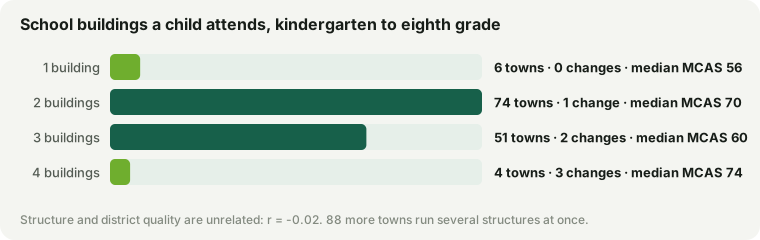
| Buildings, K to 8 | Changes of school | Towns | Median MCAS | Median 4BR |
|---|---|---|---|---|
| 1 | 0 | 6 | 56th | $1.1M |
| 2 | 1 | 74 | 70th | $825k |
| 3 | 2 | 51 | 60th | $775k |
| 4 | 3 | 4 | 74th | $975k |
The common arrangement, in 74 towns, is the one most people picture: an elementary school then a middle school, one change. But 51 towns split it three ways and 4 split it four. At the other end, 6 towns never move a child at all.
The structures themselves
| Path from K to 8 | Towns | For example |
|---|---|---|
| K–5 → 6–8 | 55 | New Bedford, Newton, Framingham |
| K–2 → 3–5 → 6–8 | 19 | Franklin, Milford, Easton |
| K–4 → 5–8 | 12 | Attleboro, Beverly, Wakefield |
| K–8 | 6 | Malden, Brookline, Methuen |
| K–6 → 7–8 | 6 | Acton, Salisbury, Pembroke |
| K–4 → 5–6 → 7–8 | 5 | Westfield, Shrewsbury, Chelmsford |
| K–3 → 4–5 → 6–8 | 5 | Norton, Weston, Newburyport |
| K–1 → 2–4 → 5–8 | 5 | Medway, Hanover, South Hadley |
The K–5 then 6–8 pattern covers 55 towns and is what most families assume they are getting. Everything below it in that table is a town where the assumption is wrong.
It says nothing about quality
The obvious question is whether one structure works better. In this data, there is no sign of it. The correlation between the number of buildings and the district’s MCAS percentile is -0.02 — indistinguishable from nothing. Every arrangement appears at every level of quality.
The clearest demonstration is the top of the table. Of the 22 Tier 1 towns with a single clear structure, the split runs right across the range:
| Tier 1 towns | How many |
|---|---|
| 1 building K–8 | 3 |
| 2 buildings K–8 | 12 |
| 3 buildings K–8 | 5 |
| 4 buildings K–8 | 2 |
A top-rated district is as likely to move your child four times as once. Hopkinton and Carlisle both sit at the very top and do opposite things. So this is not a quality signal to optimise — it is a difference in the experience, and worth knowing before you buy rather than after.
The towns at each extreme
Four buildings, three moves
| Town | The path | Tier | MCAS |
|---|---|---|---|
| Hopkinton | K–1 → 2–3 → 4–5 → 6–8 | 1 | 99th |
| Southborough | K–1 → 2–3 → 4–5 → 6–8 | 1 | 97th |
| Tewksbury | K–1 → 2–4 → 5–6 → 7–8 | 3 | 51st |
| Belchertown | K → 1–3 → 4–6 → 7–8 | 3 | 45th |
Two of these four are among the most expensive and highest-scoring districts in the state. The pattern is a deliberate design — narrow grade bands let a school specialise everything, from the furniture to the staff training, around children of nearly the same age. Parents who like it say the buildings feel purpose-built. Parents who do not say their child is always the new one.
One building, no moves
| Town | Schools in town | Tier | MCAS |
|---|---|---|---|
| Carlisle | 1 | 1 | 99th |
| Brookline | 11 | 1 | 93rd |
| Lincoln | 2 | 1 | 78th |
| Malden | 6 | 4 | 33rd |
| Easthampton | 1 | 3 | 29th |
| Methuen | 5 | 4 | 22nd |
These come in two kinds. Carlisle has one school and one building because the town is small enough that a single K–8 school is the whole system. Brookline has 11 separate K–8 schools serving a city of sixty thousand — a child still attends only one of them, for nine years. Same experience, opposite scale.
The towns with no single answer
The other 88 towns do not have one path. Their schools run different grade ranges — a K–5 here, a K–8 there, a 6–8 alongside — so the route depends on which school a child is assigned or chooses. Most are the larger cities. If you are looking at one of them, the count is a question for the district office about your specific address, not something a town-level figure can answer.
What to do with it
Add it to the list of things to check that no ranking covers. It matters most if you have a child who finds transitions hard, if you are choosing between two towns that look the same on every other measure, or if you are weighing a move mid-schooling and want to know how many more disruptions are built into the destination anyway.
Every town’s public elementary and middle schools, with the grades each one enrols, are now listed on its page in the town finder — so the path is there to read before you visit.
How this was measured
Grade ranges for every public school from the DESE 2025-26 enrolment-by-grade report, taken as the grades a school actually enrols. Two schools running the same range count once, because a child attends one of them; different ranges count separately, because a child attends them in turn. Pre-school is excluded — it is not part of the compulsory path and not every family uses it. Charter schools are excluded too: they are public but allocated by lottery, so they are not the assigned route. A town is counted as having one clear structure when its bands cover kindergarten through eighth grade exactly once; 88 towns do not, and are reported separately rather than averaged. District tiers and MCAS percentiles are this site’s existing figures. Figures as of September 11, 2026.