Stay in Salem, move, or pay for private school?
The question I built this site to answer, priced properly. Moving to a stronger district beat paying tuition in every scenario I modeled — including with a 3% mortgage I did not want to give up.
This is the question that made me build this site. We live in Salem. I like living in Salem. The district sits at the 21st percentile statewide on MCAS, and at some point that stops being a statistic and starts being a decision.
There are four honest options, and almost nobody prices them against each other: stay and pay for private school, stay and try the charter lottery, buy in a stronger district, or rent in one. Here is all four, costed the same way.
How this is priced
Everything below is a 10-year present value: every dollar paid, minus what comes back at sale, discounted at 4%. Buying assumes 20% down at 6.5%, 2% closing, 1% maintenance, 5% to sell. Staying charges the equity left sitting in the house, because declining to free it up is a real cost. Tuition inflates 4% a year, rent 3%.
The base case is us: a Salem owner with a 3.25% mortgage and about $300,000 left on it, one child, and a $25,000-a-year private school — the statewide average, not a top independent day school.
The answer surprised me
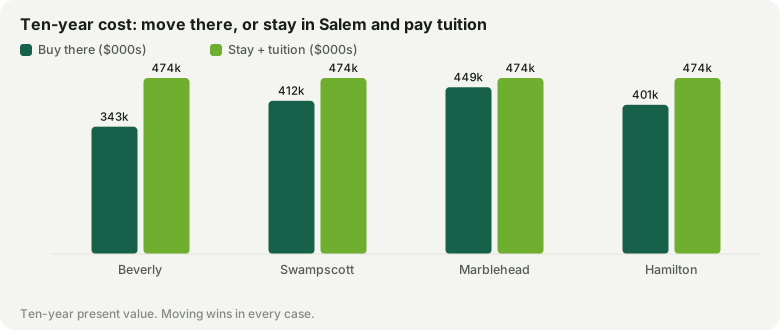
Moving beat paying tuition in every single case. Not narrowly, either. Buying in Beverly came out $131,000 cheaper over 10 years than staying put and paying for private school — and even the weakest of the four, Marblehead, still came out $25,000 ahead.
| Move to… | Buy there | Rent there | Stay + tuition | Moving saves |
|---|---|---|---|---|
| Beverly | $343,000 | $364,000 | $474,000 | $131,000 |
| Swampscott | $416,000 | $371,000 | $474,000 | $58,000 |
| Marblehead | $449,000 | $371,000 | $474,000 | $25,000 |
| Hamilton | $405,000 | $359,000 | $474,000 | $69,000 |
Why this contradicts our earlier article — and why both are right
We ran this same model for Salem against Lexington and staying put won. Here it loses every time. That is not an error in one of them; it is the actual lesson.
A 3BR in Lexington is around $1.35M. A 3BR in Beverly is $650k. When the upgrade costs three-quarters of a million dollars, tuition is the cheaper way to buy schooling. When the upgrade costs $75k — which is what leaving Salem for Beverly actually costs on a townhouse — it is not close. The answer is set by the price of the upgrade, not by the price of the tuition. That is why “is private school worth it?” has no general answer.
Does my cheap mortgage save it? No.
This was the part I most expected to rescue staying put. A 3.25% mortgage is worth real money and I did not want to give it up. Varying only that rate:
| Existing mortgage rate | Stay + tuition | Buy in Beverly | Cheaper |
|---|---|---|---|
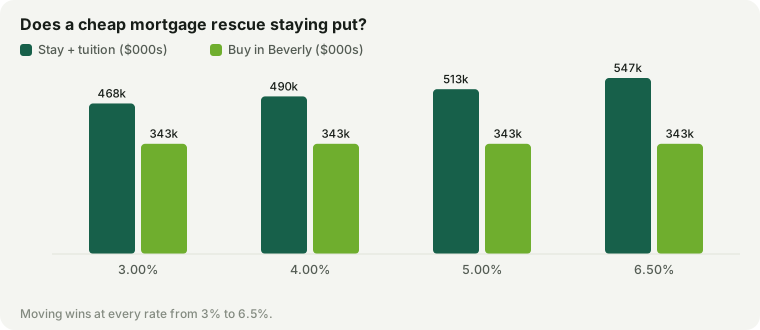
| 3.00% | $468,000 | $343,000 | Moving |
| 4.00% | $490,000 | $343,000 | Moving |
| 5.00% | $513,000 | $343,000 | Moving |
| 6.50% | $547,000 | $343,000 | Moving |
Moving wins at every rate from 3% to 6.5%. The cheap mortgage is worth a lot — it just is not worth as much as thirteen years of tuition.
Two children changes the scale, not the direction
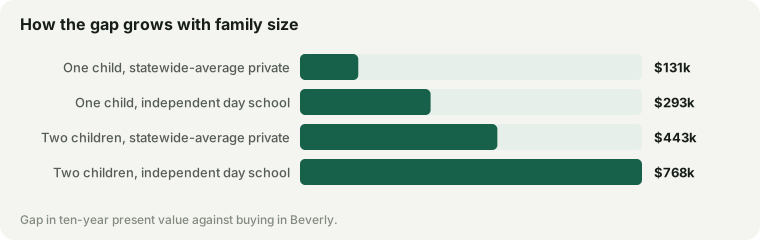
Rent is the same whether you have one child or three. Tuition is not. Against buying in Beverly:
| Your situation | Stay + tuition | Buy in Beverly | Gap |
|---|---|---|---|
| One child, statewide-average private | $474,000 | $343,000 | $131,000 |
| One child, independent day school | $636,000 | $343,000 | $293,000 |
| Two children, statewide-average private | $786,000 | $343,000 | $443,000 |
| Two children, independent day school | $1,111,000 | $343,000 | $768,000 |
Two children at an independent day school reaches a $768,000 gap. At that point this is not a close financial call; it is a question about what you want your life to look like.
What about the charter lottery?
Salem families have real charter options — we count 3 charter schools in or near Salem, and they are public and tuition-free, which is why they do not appear as a cost line above. The catch is that you cannot plan around one. Admission is by lottery, not address, and a seat is never guaranteed for a given child in a given year.
So the honest way to treat a charter is not as a fifth option but as an upside on the “stay” row: if you win a seat, staying gets dramatically cheaper; if you do not, you are back to the numbers above, possibly a year later with less time to move before school starts. I would not build a plan whose best case requires winning a lottery — but I would absolutely enter it. The Salem town page lists the charter and private options with what we know about each.
What the model cannot price — and why we have not moved
Everything above is money. Money is the part that is tractable, which is exactly why it is the part that gets over-weighted.
- Salem is the thing you would be giving up. It scores 10/10 on culture, 9/10 for a compact centre and 9/10 on energy — the highest of any town in this comparison, and higher than most of Massachusetts. My model does not have a column for walking to dinner, and it is not worth $131,000 on a spreadsheet, which tells you something about the spreadsheet.
- A district average is not your child. The 21st percentile is a district-wide figure. Individual schools, teachers and programs vary inside that, and a specific private school may fit a specific child in ways no percentile captures.
- Moving costs more than the model says. Friendships, a partner’s commute, a mid-school-year disruption, and the simple fact that you may not get to buy the house you want in the town you picked.
We have not moved. The numbers say we probably should, and I publish them anyway — including the ones that argue against the choice I have made — because that is the only version of this site worth having. What the numbers actually bought me was clarity about what staying costs, and that is a better thing to own than a decision made in the dark.
Run these numbers on your own situation with the rent, buy or tuition calculator, or compare the towns directly in the comparison tool. Prices, tuition and commutes are estimates; school data is from MA DESE. Data last reviewed . Sources in the methodology. Nothing here is financial advice.