The same schools cost $520,000 more in the next town over
Among the towns this site covers, seventeen districts enroll children from more than one town into the same buildings — same teachers, same superintendent, one state rating, one per-pupil figure. That makes them the only clean test of what a district is worth, because the schools are held constant and everything left over is the town. Chatham and Harwich share Monomoy, and the typical three-bedroom home is $520,000 dearer in Chatham. Nine of the seventeen have a member town at least a tenth cheaper than its neighbor.
The hard part of pricing a school district is that nothing about a district varies on its own. A strong district is usually also close to Boston, on larger lots, in a town that was expensive before the schools were good. A regression can pull those apart, and this site has run one — but a coefficient is an argument, not an address.
Among the towns this site covers, 17 districts run the experiment properly. They enroll children from more than one town into the same buildings: same teachers, same superintendent, one per-pupil figure, one state accountability determination, one graduation rate. Hold every one of those constant and whatever price difference is left between the member towns is, by construction, not the schools.
Chatham and Harwich are one school district
Monomoy Regional enrolls both towns. It spends $25,510 per pupil — one figure, because it is one budget. It graduates 97.4% of its students. A family in Harwich and a family in Chatham send their children to the same schools.
The typical three-bedroom home is $769k in Harwich and $1.29M in Chatham — a difference of $520k, or 1.68x, for an identical education.
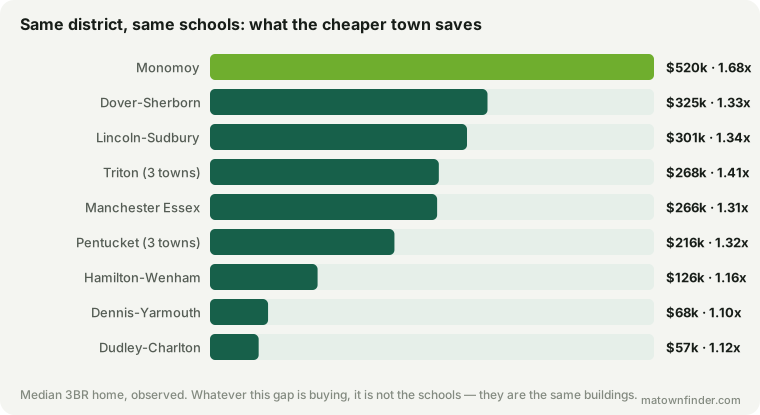
9 of the 17 are separated by at least a tenth. The other 8 are near enough to identical that the difference sits inside the noise of any price estimate — which is worth saying plainly, because it means this is not a trick that works everywhere. The median shared district spans $57k. The interesting ones are the handful at the top.
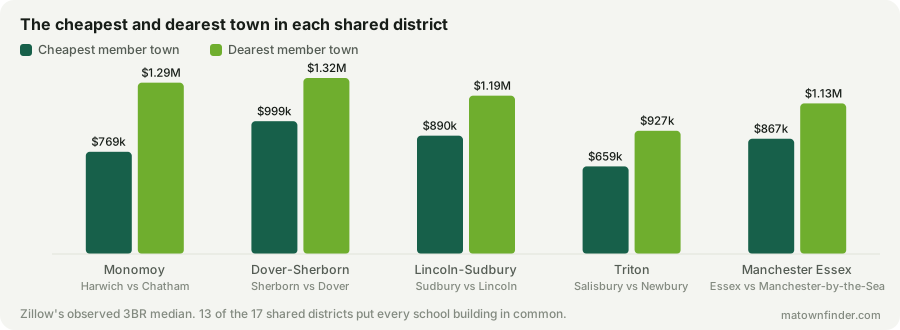
All 17, with what separates them
Districts with three member towns show the extremes; the middle town is on the district page. A gap under $10k is left blank rather than reported as a finding.
It is not the commute either
The reflex after schools is distance, and distance cannot carry this. Across the 9 wide districts, the most a buyer gives up in commute by choosing the cheaper town is 8 minutes — Sudbury against Lincoln, for $301k. In 2 of them the cheaper town is actually the shorter commute: Harwich (106 min) against Chatham (113), and Yarmouth (101 min) against Dennis (102).
What is left is the thing itself: the water, the harbor, the village center, the address. Chatham is a destination and Harwich is where you live near it. That is a real difference and people pay $520k for it — but they should know that is what they are buying, because the schools are already included in the cheaper price.
The tax bill takes some of it back, slowly
A cheaper town usually needs a higher rate to raise the same money, so part of the saving comes back every year. Taxed on the same house, the cheaper member carries the higher bill in 6 of the 9.
Dennis-Yarmouth is the strongest case for taking that seriously, and it still is not close. Yarmouth saves $68k on the house and pays about $1,900 a year more in property tax on it. At that rate the tax difference catches the price difference in 36 years, whichis far longer than most people own one. The other direction — a low rate on a dear house — is the one that costs real money.
What this does not prove
Three limits, all of which narrow the claim rather than undo it.
- Not every district shares every year. 13 of the 17 put every school building in common. Concord-Carlisle and Lincoln-Sudbury are regional high school districts; the member towns run their own elementary schools, so only the last four years are genuinely held constant.
- Identical schools are not identical outcomes. One district-wide graduation rate and one MCAS percentile cover both towns, which is the point — but a district can still serve two towns differently within the same buildings, and nothing in this data would show it.
- Two price sources, and they do not always agree. In 3 districts — Acton-Boxborough, Bridgewater-Raynham, Groton-Dunstable — this site’s own modeled 4BR estimate puts the towns in the opposite order from Zillow’s observed 3BR median. All 3 are among the narrowest here, at 3% or less. Where the two sources disagree, the honest reading is that the towns cost the same.
How to use this
- Search the district, not the town. If a district is what you want, which member town you buy in is a separate decision, and a much cheaper one. Harwich buys the same schooling as Chatham for $520k less.
- Read the gap as the price of the place. With schools held constant it is the cleanest number on this site for what a town’s character, water and address are worth on their own.
- Check which years are shared. A regional high school district and a fully regional one are different purchases, and the table above says which is which.
How this was measured
District membership comes from each town’s resident-serving district in the DESE per-pupil report, and shared buildings are matched on DESE org codes rather than school names — several names repeat across unrelated districts in the state, and a name match would eventually claim two towns share a school neither has heard of. Only districts serving more than one town appear; each has its own page.
Prices are Zillow’s observed median for a three-bedroom home, houses and condos together, rather than this site’s modeled 4BR estimate. Two reasons: the argument is a comparison between two real neighboring towns, and the site’s model rounds to $25,000 steps, which is wide enough to hide a genuine difference between neighbors. Tax bills are each town’s FY2026 residential rate applied to one shared house — the district’s own median 3BR — so the rate is isolated from the price. See the methodology, or download the tables. Figures as of September 11, 2026.