The most compact town centers in Massachusetts — and what they cost
Compact, town-centered places are not the preserve of Cambridge and Brookline. Several score as compact as the famous names and sell for less than half.
“Walkable” in Massachusetts usually gets said about the same handful of places — Cambridge, Somerville, Brookline, the North End. They deserve it. But they are not the only compact, town-centered places in the state, and treating them as such quietly turns a walkable layout into something only a $1.5M budget can buy.
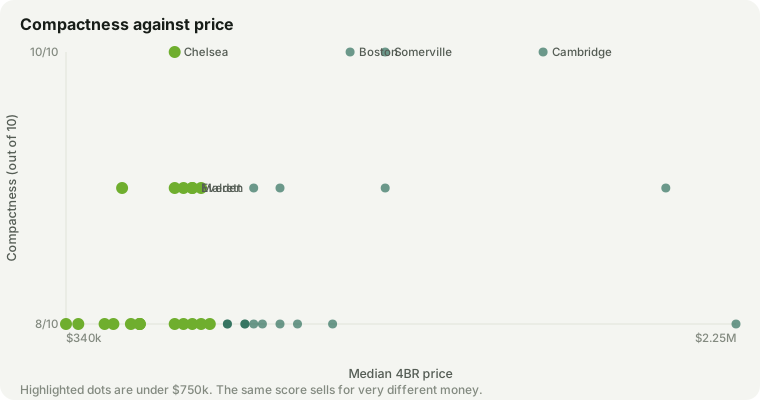
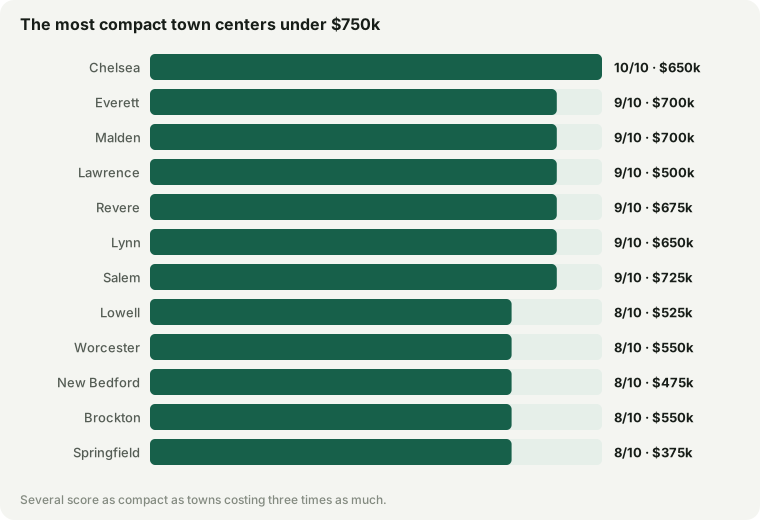
So we scored it. Of the 37 Massachusetts municipalities that rate 8 or higher for a compact, town-centered built environment, 20 have a median 4BR under $750k — and several score as compact as Cambridge does.
The finding
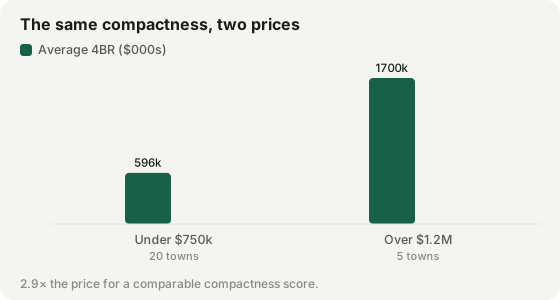
Among the most compact town centers, the expensive ones average about $1.7M for a 4BR and the affordable ones about $596k. That is roughly 2.9× the price for the same compactness score. The difference is not how compact the place is. It is which compact place carries a prestige premium.
Chelsea, Everett, Malden, Lynn and Revere are dense, centered, transit-served cities built before the car. They score as compact as the famous names because they were built the same way — and they are priced like the working cities they still are.
Every town scoring 8+ for a compact center
Sorted by compactness score, then density. All 37 of them.
| # | Town | Compact center | People / sq mi | 4BR house | Commute | Rail |
|---|---|---|---|---|---|---|
| 1 | Somerville | 10/10 | 19,652 | $1.25M | 14 min | T 6m |
| 2 | Cambridge | 10/10 | 18,512 | $1.7M | 14 min | T 6m |
| 3 | Chelsea | 10/10 | 18,381 | $650k | 24 min | Rail 18m |
| 4 | Boston | 10/10 | 13,977 | $1.15M | 8 min | — |
| 5 | Everett | 9/10 | 14,366 | $700k | 24 min | — |
| 6 | Malden | 9/10 | 13,137 | $700k | 19 min | T 11m |
| 7 | Lawrence | 9/10 | 12,863 | $500k | 58 min | Rail 59m |
| 8 | Revere | 9/10 | 10,902 | $675k | 25 min | T 17m |
| 9 | Lynn | 9/10 | 9,429 | $650k | 40 min | Rail 28m |
| 10 | Brookline | 9/10 | 9,348 | $2.05M | 24 min | T 21m |
| 11 | Arlington | 9/10 | 9,004 | $1.25M | 34 min | — |
| 12 | Watertown | 9/10 | 8,841 | $950k | 31 min | — |
| 13 | Quincy | 9/10 | 6,133 | $875k | 22 min | T 14m |
| 14 | Salem | 9/10 | 5,363 | $725k | 47 min | Rail 38m |
| 15 | Winthrop | 8/10 | 9,702 | $850k | 34 min | — |
| 16 | Lowell | 8/10 | 8,490 | $525k | 58 min | Rail 47m |
| 17 | Medford | 8/10 | 7,366 | $900k | 16 min | T 8m |
| 18 | Melrose | 8/10 | 6,366 | $950k | 28 min | Rail 16m |
| 19 | Worcester | 8/10 | 5,528 | $550k | 77 min | Rail 84m |
| 20 | Waltham | 8/10 | 5,118 | $1M | 36 min | Rail 44m |
| 21 | New Bedford | 8/10 | 5,054 | $475k | 86 min | Rail 94m |
| 22 | Brockton | 8/10 | 4,952 | $550k | 50 min | Rail 38m |
| 23 | Springfield | 8/10 | 4,893 | $375k | 116 min | — |
| 24 | Randolph | 8/10 | 3,559 | $650k | 44 min | Rail 32m |
| 25 | Weymouth | 8/10 | 3,426 | $725k | 40 min | Rail 28m |
| 26 | Norwood | 8/10 | 3,046 | $800k | 42 min | Rail 38m |
| 27 | Wellesley | 8/10 | 2,949 | $2.25M | 39 min | Rail 38m |
| 28 | Framingham | 8/10 | 2,889 | $800k | 52 min | Rail 57m |
| 29 | Braintree | 8/10 | 2,844 | $875k | 33 min | T 25m |
| 30 | Fall River | 8/10 | 2,838 | $450k | 82 min | Rail 103m |
| 31 | Dedham | 8/10 | 2,470 | $850k | 36 min | Rail 29m |
| 32 | Newburyport | 8/10 | 2,190 | $1.1M | 71 min | Rail 71m |
| 33 | Maynard | 8/10 | 2,063 | $750k | 54 min | — |
| 34 | Holyoke | 8/10 | 1,806 | $340k | 120 min | — |
| 35 | Holbrook | 8/10 | 1,572 | $550k | 44 min | Rail 36m |
| 36 | Amherst | 8/10 | 1,421 | $675k | 112 min | — |
| 37 | Northampton | 8/10 | 863 | $700k | 121 min | — |
How this was scored
The compactness figure is the built environment dimension of our town vibe model: a 1–10 editorial read of how compact and town-centered a place is, from rural and car-dependent at the low end to dense and continuously built at the high end. We cut the list at 8, the rubric’s “town-centered, compact or partly walkable” band and above. Population density is shown next to it as the supporting Census figure, since the two should broadly agree — and here they do.
What this does not measure
- It is not a walkability measure, and we stopped calling it one. This score reads compactness and town-centeredness. It does not test what actually determines whether you can walk somewhere: how many destinations sit within a ten- or fifteen-minute walk, intersection density, sidewalk coverage, street connectivity, safe crossings, major-road barriers, transit-stop access, or the walk-to-work share. A place can be dense and still unpleasant on foot — a six-lane road through the middle, no crossings, winter that never gets cleared. Until those are measured, treat this as layout rather than pedestrian access, and stand on the corner yourself.
- Cheaper is cheaper for reasons this table does not hold. School tiers, tax bills and commute vary a lot across this list. Lawrence has a genuinely compact centre and a genuinely long commute. Use the finder to weigh those together rather than reading this column alone.
- Amenity counts are mapped, not censused. Where we cite café counts elsewhere, those come from OpenStreetMap and undercount thinly-mapped places — see the methodology.
Compactness scores from our six-dimension town vibe model; density from the Census; prices are estimates calibrated to the Zillow Home Value Index and Redfin; commutes are modeled, with rail legs from the MBTA timetable. Data last reviewed . Full sources in the methodology.