Private school is not a plan B for a weak school district
A Tier 1 town has a median of 36 accredited private schools within twelve miles, and none has fewer than seven. Sixteen towns have none at all — every one of them Tier 3 or Tier 4.
The thought arrives late in almost every house hunt. The town that works on price has a school district that does not, and someone says: we could buy here and go private. It is a reasonable-sounding trade — swap a bigger mortgage for tuition, and buy the schooling directly instead of through the house.
It rests on an assumption nobody checks, which is that the private schools are there to be bought. So we counted. Across 241 Massachusetts towns and 443 private schools, the fallback is thinnest in exactly the places that would need it.
Where the schools actually are
Start with the good news, because it is real: there is no town in Massachusetts without a private school within 12 miles. Not one. If the question is merely whether a private school exists nearby, the answer everywhere is yes.
That is a lower bar than it sounds. Massachusetts publishes nothing about how a private school performs — they sit no MCAS and report no results to the state. The only outside check on any of them is accreditation: a review against published standards, on a ten-year cycle, by AISNE for the elementary and middle schools or NEASC for the secondary ones. Of the 443 private schools here, 148 hold one.
Ask for an accredited school instead of merely a private one and the map thins out fast.
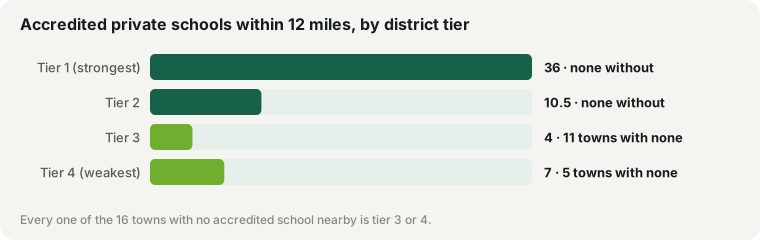
| District tier | Towns | Median accredited within 12 mi | Fewest | Towns with none |
|---|---|---|---|---|
| Tier 1 (strongest) | 23 | 36 | 7 | 0 |
| Tier 2 | 42 | 10.5 | 1 | 0 |
| Tier 3 | 112 | 4 | 0 | 11 |
| Tier 4 (weakest) | 64 | 7 | 0 | 5 |
A Tier 1 town has a median of 36 accredited private schools within 12 miles. A Tier 3 town has 4. The worst-served Tier 1 town in the state still has 7.
Tier 4 in that table looks better than Tier 3 — 7 against 4 — and that is an artefact of our own town list rather than a finding. Boston’s neighbourhoods are separate entries here, because a family weighing Roslindale against Newton is making a real choice, and all 19 of them are Tier 4 sitting on the densest concentration of private schools in the state — a median of 68 apiece. In effect the city is counted nineteen times. Take those rows out and Tier 4’s median falls to 4, which is exactly Tier 3’s 4. Statewide, the two weakest tiers are indistinguishable and the whole advantage sits with the strong districts.
And 16 towns have none at all. Every one of them is Tier 3 or Tier 4:
Barnstable, Raynham, Rehoboth, Seekonk, Bridgewater, Taunton, Somerset, Swansea, Sturbridge, Charlton, Middleborough, Southwick, Webster, Dudley, Palmer, Southbridge.
The pattern holds however hard you push on it. Tighten the radius to ten miles and the list grows; widen it to fifteen and it shrinks; at either setting every town on it is still Tier 3 or Tier 4. No town with a strong district has ever been on it.
But the cause is not the districts
It would be neat to conclude that private schools avoid weak districts. The numbers do not support it, and the honest version is more useful.
Across every rated town, the correlation between district tier and the number of accredited schools nearby is -0.03 — which is to say none at all. The correlation with distance from Boston is -0.65. Private school supply is a map of the Boston metro, not a map of educational need.
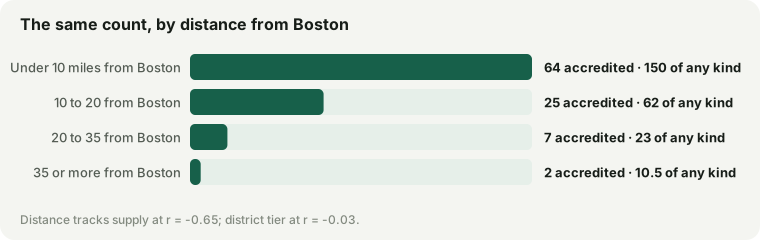
| Distance from Boston | Towns | Median private within 12 mi | Median accredited |
|---|---|---|---|
| Under 10 miles | 43 | 150 | 64 |
| 10 to 20 | 51 | 62 | 25 |
| 20 to 35 | 77 | 23 | 7 |
| 35 or more | 70 | 10.5 | 2 |
A town inside ten miles of Boston sees a median of 64 accredited schools. A town 35 or more miles out sees 2. That is the whole story of supply, and it is the same story this site keeps running into: most of what looks like a schools question in Massachusetts is a proximity question wearing a different hat.
Hold distance still and it gets worse
Here is the part that matters for the trade families are actually considering. Take only the towns between 15 and 35 miles of Boston — 105 of them, all a plausible commute, all roughly the same distance from the city’s supply of schools. Distance is no longer doing the work. Now compare them by district tier.
| District tier | Towns in the band | Median accredited within 12 mi |
|---|---|---|
| Tier 1 | 13 | 16 |
| Tier 2 | 29 | 10 |
| Tier 3 | 49 | 5 |
| Tier 4 | 14 | 7 |
Within that band the correlation turns real — -0.39 — and it runs the wrong way for the plan-B theory. At the same commute, the towns with the strongest districts have the most private schools around them: 16 for Tier 1 against 5 for Tier 3. Independent schools sit where the money and the demand already are, and so do good public districts. They are not alternatives to each other so much as two symptoms of the same thing.
What this changes
Not the arithmetic of tuition against a mortgage — that is a separate question, and we have run it. What it changes is whether the option is on the table at all.
If you are looking at a Tier 3 town thirty-five miles out and holding private school in reserve, check the reserve before you rely on it. The median town in that position has a handful of accredited schools within reach and 16 towns have none. Meanwhile the Tier 1 town you decided was unaffordable comes with 36 of them — an option its buyers are least likely to need.
The plan B is real. It is just distributed like a luxury, not like a remedy.
How this was counted
Every private school on this site with a location — 443 of them — measured against all 241 town centres by straight-line distance. Straight-line flatters everywhere equally and understates nothing in particular. The town pages show at most eighteen schools each, so the counts here come from the schools’ own locations rather than those lists, which would truncate every town near Boston.
Accreditation is from the AISNE member directory, which records whether a school holds AISNE or NEASC accreditation. It is a statement that a school has been reviewed against published standards, not a measure of results, and not a ranking. Its absence is not a mark against a school — plenty of good ones are not members. It is used here because it is the only external check that exists on Massachusetts private schools, which makes its distribution worth knowing even though it is a rough instrument.
District tiers are this site’s own, built from state assessment data; Tier 1 is strongest. Correlations are Pearson’s r, quoted to say which of two things tracks supply, not to claim either causes it. Figures as of September 11, 2026. You can check any town against this in the town finder, which lists the private and charter options near each one.