The child care near you depends on what your town costs
Massachusetts licenses two different things under one word: centers on commercial premises averaging 69 places, and family programs in a provider’s own home averaging eight. Two programs in three are the home kind — but which one is near you tracks what the town costs. In the cheapest quarter of towns, 67% of programs are somebody’s home; in the dearest, 25%. Eleven towns have no home-based program at all, Weston, Dover and Carlisle among them.
Families choose a town for the schools. They read the district rankings, work out what the premium costs, and move. Almost nobody checks what happens in the four or five years before any of that applies — and those are the years that cost the most and are hardest to arrange.
Massachusetts licenses 7,925 child care programs across the 222 towns covered here, and the word “program” is doing a lot of work. Two entirely different things sit underneath it.
Two things, one word
A center is commercial premises. The state licenses it room by room, with a separate capacity recorded for each age band, and the average one here holds 69 children. A family child care program is a provider’s own home, with a mixed-age group and an average of 8 places. Both are licensed and inspected by the same department. Neither is the junior version of the other: the hours, the price, the group size and the daily experience all differ, and plenty of families prefer the home.
By count, the home is the normal case. 5,276 of the 7,925 programs — 67% — are family child care. By places they are a minority, because eight against sixty-nine is not a close contest: 19% of the state’s licensed capacity. Most programs are somebody’s house; most places are in a building.
Which one is near you
Here is the part nobody tells a family choosing a town. The mix is not the same everywhere, and it does not vary randomly. It tracks what the town costs.
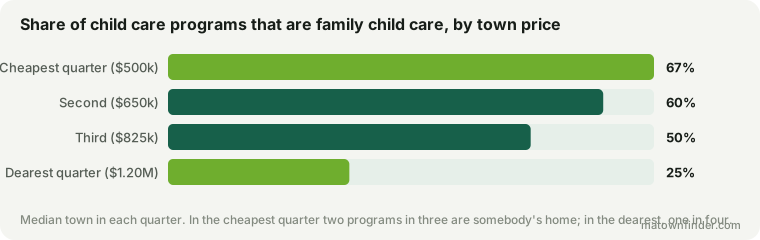
In the cheapest quarter of towns, a median of 67% of programs are family child care. In the dearest quarter — median 4BR $1.2M — it is 25%. Across all 222 towns the correlation between price and the family-care share is r = -0.59, which for a single town characteristic against a single market structure is strong.
The same gradient runs down the school tiers, which is the version that matters to somebody moving for a district.
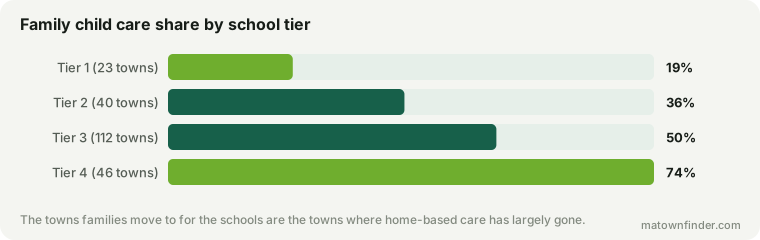
Tier 1 towns are a median 19% family child care. Tier 4 towns are 74%. The towns families move to for the schools are, with striking consistency, the towns where home-based care has largely disappeared — r = 0.64 against the tier.
Is it just that cheap towns are bigger?
It is the obvious objection and it is worth taking seriously: the Gateway Cities are large and dense, and dense places might simply support more home-based providers. The data says no. Town population barely moves the mix at all — r = 0.2, against -0.59 for price.
The cleaner test is to hold size roughly constant and look only at price. Among towns of at least 25,000 people, split into a cheaper and a dearer half:
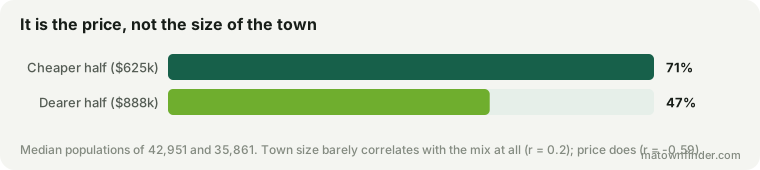
Median populations of 42,951 and 35,861 — near enough identical — and the family-care share still falls from 71% to 47%. Same size of town, different price, different kind of care.
The ends of the range
At one end, Lawrence: 495 of its 527 programs are family child care, 94%. Lowell 93%, Fitchburg 93%, Everett 92% follow it.
At the other end are 11 towns with no family child care program at all — not a small share, none: Weston, Dover, Carlisle, Manchester-by-the-Sea, Chatham, Boxborough, Wenham, West Newbury, Essex, Great Barrington, Williamstown. Every one of them has at least one center, so this is not a shortage of child care. It is the absence of one of the two kinds. A family that wants a home setting, or wants the hours a home setting often keeps, will not find one in the town they moved to.
Which is worth sitting with, because the list reads like a roll call of the districts people move for: Weston, Dover and Carlisle are Tier 1; Wenham and Essex are Tier 2. The premium buys the schools. It also, and without telling you, buys a narrower set of options for the years before them.
What this cannot tell you
One thing worth being blunt about, because it limits the whole exercise. The state records a center’s capacity age band by age band — how many infant places, how many toddler places — but a family child care program is licensed as a single mixed-age total and reports no breakdown at all. Not some of them: all 5,276 of them, covering 42,295 licensed places.
So any statement about infant supply in Massachusetts, from this data or anyone else’s, is really a statement about infant supply in centers. Family programs certainly take infants; the published data cannot say how many. It is why the town pages here call that figure center-based, and why they treat it as a floor rather than a count. It is also, quietly, the more useful finding for the state than for any individual family: the sector that is two-thirds of all licensed programs is the one nobody can measure by age.
How to use this
- Look at the mix, not just the count. A town with forty programs and a town with forty programs can offer completely different choices. Every town page now splits centers from family programs.
- If you want home-based care, check before you move. In 11 towns there is none, and in the dearest quarter it is a quarter of the market rather than two-thirds.
- If you want a center, the cheap towns have them too. Not one of the 222 towns is without a center. The difference is what surrounds it.
- Do not read a low infant number as no infant care. It counts centers only, so in a town whose supply is mostly home-based it is close to meaningless.
How this was measured
Every licensed program in the Massachusetts Department of Early Education and Care’s licensing database, as republished monthly on the state’s Education-to-Career hub, pulled 2026-08-02. That file is an archive of monthly snapshots, so only the newest one is a picture of today. Programs whose licence has expired are excluded. Licences record the postal city, which means villages and spelling variants — Hyannis, South Lawrence, Middleboro — are resolved to the town that contains them; place names outside the 222 towns this site covers are left out rather than guessed at.
The family-care share is a ratio of programs within a town, which is why this article is about the mix and not about places per child: the mix needs no population denominator and no age breakdown, and is therefore the thing this data can actually support. Prices and school tiers are this site’s own, as everywhere — see the methodology. Licensed capacity is a ceiling programs may operate to, never a count of free places. Figures as of September 17, 2026.